
Online CBT for Social Anxiety: An Evidence-Based Guide to Lasting Confidence

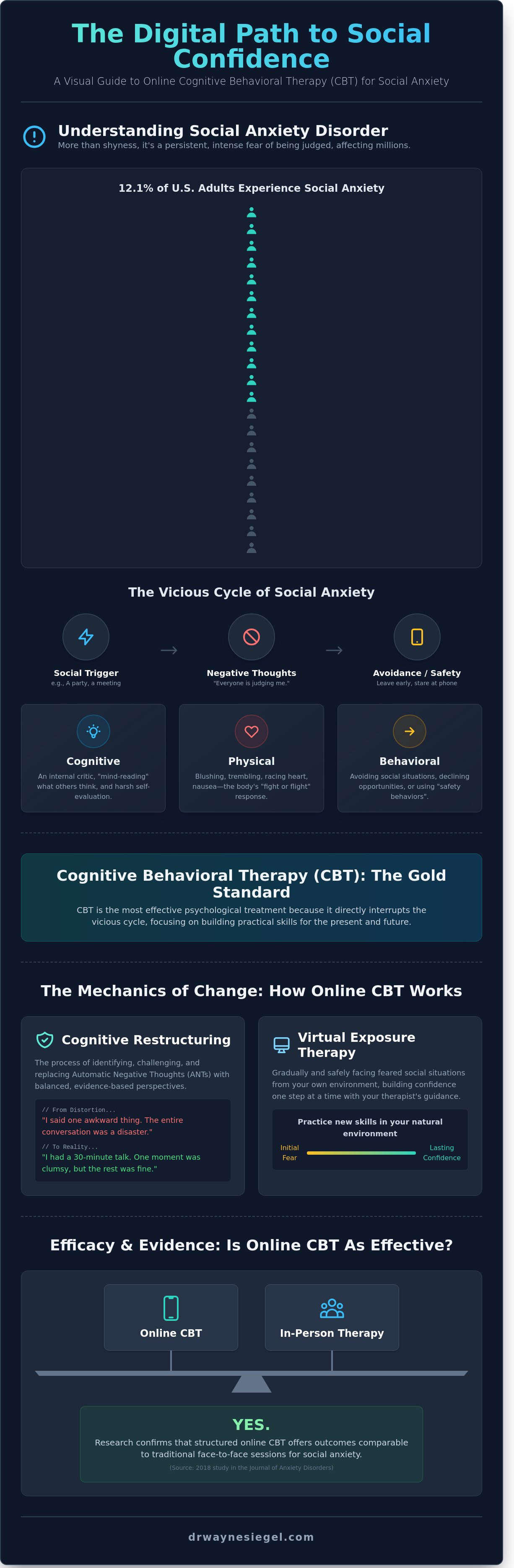
What if the very screen you often use to avoid the world became the most powerful tool for re-entering it? If you're among the 12.1% of U.S. adults who experience social anxiety at some point in their lives, you know how heavy the weight of judgment feels. It's understandable why you might feel that sitting in a physical clinical office is just another social hurdle you aren't ready to clear. Research from a 2018 study in the Journal of Anxiety Disorders confirms that online cbt for social anxiety is just as effective as traditional face-to-face therapy. You can begin your recovery in a space where you already feel safe.
I've seen how the right structure can transform a life of avoidance into one of quiet confidence. My goal is to provide you with a clear roadmap that demystifies the process of digital therapy. In this guide, I'll explain exactly how evidence-based cognitive behavioral techniques work in a virtual setting and what steps you can take to find a specialist who understands your unique cognitive profile. We'll move beyond the confusion of endless apps to find a professional path that offers the clarity and lasting change you deserve.
Key Takeaways
- Understand the "vicious cycle" of social anxiety and why Cognitive Behavioral Therapy remains the gold standard for achieving lasting change.
- Learn how online cbt for social anxiety empowers you to identify and dismantle the automatic negative thoughts that arise in social settings.
- Explore the clinical research confirming that structured remote therapy offers outcomes comparable to traditional face-to-face sessions.
- Gain clarity on how to choose a high-quality program by identifying the essential markers of professional clinical excellence.
- Discover how a personalized roadmap can bridge the gap between scientific rigor and compassionate, person-centered care.
What is Social Anxiety Disorder and Why CBT is the Gold Standard
I often meet individuals who describe themselves as "just shy," yet they feel a profound sense of paralysis in everyday situations. Social Anxiety Disorder is far more than a personality trait or a preference for solitude. It's a persistent, intense fear of being watched, judged, or scrutinized by others. Data from the National Institute of Mental Health indicates that approximately 12.1% of U.S. adults experience this disorder at some point in their lives. It creates a self-sustaining cycle where anxious thoughts trigger physical discomfort, leading to the avoidance of the very situations that could help you grow. My goal is to help you find clarity within this cycle and provide a roadmap toward relief.
Cognitive Behavioral Therapy (CBT) stands as the gold standard because it directly interrupts this loop. We don't just analyze the past; we focus on the mechanics of your current experience to build a better future. A 2018 meta-analysis published in The Lancet confirmed that CBT is the most effective psychological treatment for social anxiety, often outperforming other therapies and even medication in the long term. When we utilize online cbt for social anxiety, we're taking these same rigorous, evidence-based principles and delivering them in a format that respects your boundaries and your schedule.
The Core Symptoms Targeted by CBT
- Cognitive: This involves the "internal critic." You might struggle with mind-reading, where you're certain others are thinking the worst of you, or negative self-evaluation after every interaction.
- Physical: Your body reacts as if it's under physical attack. Common symptoms include blushing, trembling, a racing heart, or nausea when you're the center of attention.
- Behavioral: This is the avoidance piece. It might look like declining a promotion to avoid meetings or using "safety behaviors," such as staying on your phone during a party to avoid eye contact.
The Evolution of Internet-Based CBT (ICBT)
The transition from traditional office-based therapy to structured online protocols has been a significant milestone in neuropsychological care. By 2026, telehealth has matured into a primary mode for specialized treatment, offering a level of precision that was previously difficult to achieve. The core therapeutic ingredients, such as cognitive restructuring and gradual exposure, remain identical to face-to-face sessions. I've found that online cbt for social anxiety is particularly effective because it allows you to practice new skills in your natural environment. This digital shift removes the initial barrier of traveling to a clinic, which is often a major hurdle for someone struggling with social fears. It transforms the therapeutic process into a personal partnership that fits seamlessly into your daily life, moving you closer to the quality of life you deserve.
The Mechanics of Change: How Online CBT Works for Social Anxiety
I view CBT as a practical toolkit rather than just a talk therapy. It focuses on the interplay between your thoughts and your actions. When we use online cbt for social anxiety, we start by identifying Automatic Negative Thoughts (ANTs). These are the reflexive, often harsh judgments that flood your mind during a Zoom call or a coffee date. Statistics from the 2021 National Survey on Drug Use and Health indicate that social anxiety affects roughly 15 million American adults. Understanding that these thoughts are symptoms, not facts, is our first step toward relief. This dual-focus approach ensures we aren't just discussing problems; we're actively retooling your brain's response to social stress.
Cognitive Restructuring in a Digital Environment
We work together to dismantle cognitive distortions such as "all-or-nothing" thinking or "catastrophizing." This might look like believing a single awkward silence ruins an entire 30-minute conversation. Cognitive restructuring is the systematic process of replacing maladaptive thoughts with evidence-based perspectives. In a virtual setting, I use digital worksheets and secure messaging to help you track these patterns in real time. This allows us to capture data when your anxiety is actually happening. You can gain clarity on your cognitive profile by documenting these moments as they occur between our scheduled sessions.
Virtual Exposure Therapy: Facing Fears from Home
Exposure therapy involves leaning into discomfort in a controlled, gradual way. We often begin with "imaginal exposure," where you visualize a social scenario for 5 to 10 minutes while practicing regulation techniques. We then move to "in-vivo" tasks, which are real-world challenges assigned as homework. Using your home as a secure base provides a unique advantage. It acts as a safe harbor where you can decompress immediately after a challenge. As highlighted by the NIMH on Social Anxiety Disorder, this structured approach helps the brain relearn that feared situations are actually safe. Our therapeutic alliance, maintained through high-definition video conferencing, ensures you never feel alone during these exercises.
We also conduct behavioral experiments to test the validity of your social fears. If you believe "people will laugh if I misspeak," we design a small test where you intentionally pause or stumble during a low-stakes video call. We then analyze the actual outcome versus your prediction. In a high percentage of these experiments, patients find that their feared catastrophe simply doesn't happen. This evidence-based feedback is what builds lasting confidence. I am there to guide the process, ensuring each step is challenging yet manageable. By identifying the specific triggers that lead to avoidance, we can build a roadmap for your recovery together.
Efficacy and Evidence: Is Online CBT as Effective as In-Person Therapy?
When I first discuss digital options with my patients, the most common concern is whether a screen might dilute the clinical impact of our work. It is a valid question. We often assume that physical proximity is a requirement for deep emotional work. However, two decades of rigorous clinical data suggest otherwise. For many individuals, online cbt for social anxiety isn't just a convenient alternative; it is a highly effective clinical tool that produces results identical to traditional office visits.
The Research Verdict on ICBT
The evidence supporting Internet-delivered Cognitive Behavioral Therapy (ICBT) is substantial. A landmark study from the Karolinska Institutet followed patients for five years after they completed their treatment. The researchers found that 92% of participants maintained their progress or even showed continued improvement half a decade later. This suggests that the skills learned through a digital interface are deeply internalized. These results aren't isolated. A 2018 meta-analysis published in the Journal of Anxiety Disorders compared ICBT directly to face-to-face therapy across various trials. The study concluded that the two formats were equally effective in reducing symptoms of Social Anxiety Disorder (SAD).
My clinical experience mirrors these findings. In many ways, the digital format provides a unique advantage for those struggling with social fears. The "screen buffer" can lower the initial barrier to entry. It allows a patient to engage in challenging exposures from a place of perceived safety before generalizing those skills to the outside world. Understanding how CBT is used to treat social anxiety reveals that the core mechanisms of change, such as cognitive restructuring and gradual exposure, don't require us to sit in the same room. They require a clear roadmap and a dedicated partnership.
The PsyPact Advantage: Accessing National Expertise
I believe that your geographic location shouldn't dictate the quality of your mental health care. In the past, patients were limited to the generalists in their immediate zip code. This was often a barrier for those with complex social anxiety who needed a specialist's touch. I utilize the PsyPact framework to solve this problem. This interstate agreement currently allows me to work with patients in 40+ participating states. You can verify your state's status by viewing the PsyPact map.
Working with a board-certified specialist through PsyPact ensures you receive a level of precision that general practitioners may not provide. We don't just talk about your week. We analyze the specific cognitive profiles and executive functions that drive your avoidance. This specialized focus is often the difference between temporary relief and a permanent shift in confidence.
Beyond clinical outcomes, the logistical benefits of online cbt for social anxiety significantly improve the "dosage" of therapy you receive. Consider these practical advantages:
- Reduced No-Show Rates: Internal data and broader clinical trends show that virtual appointments have 15% to 20% lower cancellation rates compared to in-person visits.
- Consistency: Treatment isn't interrupted by traffic, weather, or minor illnesses, which keeps the momentum of recovery steady.
- Real-World Application: We can conduct sessions from the very environments where your anxiety is most triggered, providing immediate, actionable feedback.
The perceived loss of "human connection" is a common myth I enjoy debunking. The therapeutic alliance is built on empathy, insight, and mutual goals. These elements transcend the medium. In my practice, I've found that the focus and clarity of a video session can actually sharpen our work. It creates a quiet, dedicated space where we can solve the puzzle of your anxiety with meticulous care. You aren't just a patient in a waiting room; you're a partner in a focused journey toward clarity.
Navigating Your Journey: Choosing the Right Online CBT Program
Choosing a path toward healing requires more than just a search engine; it requires a roadmap built on clinical excellence. I often tell my patients that the most critical step is identifying a provider who prioritizes evidence-based protocols over general supportive talk. One gold standard to look for is Board Certification through the American Board of Professional Psychology (ABPP). Only about 4% of licensed psychologists in the United States have achieved this distinction. It represents a rigorous, peer-reviewed validation of their expertise and ethical standing. When you choose a board-certified professional for online cbt for social anxiety, you're ensuring your care meets the highest national standards of competence. This level of certification means the practitioner has undergone additional examinations to prove they can deliver the specific results you need.
Individual vs. Self-Help Online CBT
Self-guided apps offer convenience, but they often lack the depth needed for moderate to severe anxiety. I find that the human element is what truly facilitates lasting change. The therapeutic alliance is the collaborative relationship between patient and psychologist that predicts 30% of treatment success. A clinician provides real-time course correction and nuance that an algorithm simply cannot replicate. This partnership allows us to adjust the pace of your online cbt for social anxiety based on your unique emotional responses during each session. We work together to identify the subtle safety behaviors that keep you stuck, providing a level of insight that software programs generally overlook.
Identifying Clinical Excellence
During your initial consultation, look for a balance of clinical authority and approachable empathy. A provider should offer a clear, written roadmap of what your treatment will look like. Red flags include vague descriptions of "just talking" or a refusal to use standardized protocols like the Clark and Wells model. If a therapist cannot explain the "why" behind an intervention, they may not be providing the evidence-based care you deserve. I believe that transparency is essential. You should leave the first meeting feeling that your challenges are understood and that a logical, step-by-step plan is in place to address them.
Preparing for Your First Virtual Session
Success in a digital environment requires intentionality and a commitment to your own privacy. You need a secure, HIPAA-compliant platform to protect your sensitive data; avoid providers using casual apps like FaceTime or standard Skype. Beyond the tech, find a space where you feel psychologically safe and won't be interrupted. This physical boundary creates a container for the work we do. We also move beyond general goals. Instead of saying "I want to feel better," we aim for specific, measurable outcomes, such as "I want to contribute two comments during my Tuesday team meeting by next month." This shift from vague desires to actionable life improvements is where true progress begins.
If you're ready to gain a clearer picture of your cognitive strengths and find a path forward, I invite you to schedule a consultation for a comprehensive evaluation today.
Personalized Evidence-Based Care with Siegel Psychology Services
I believe that effective therapy is a partnership built on two pillars: rigorous science and deep, person-centered empathy. When we address social anxiety, we aren't just looking at a diagnosis; we're looking at your life. My approach integrates the structured tools of Cognitive Behavioral Therapy with the psychological flexibility of Acceptance and Commitment Therapy (ACT). This combination allows us to address both the immediate symptoms of fear and the deeper values that drive your long-term fulfillment. It's a holistic method designed to help you build resilience that lasts well beyond our final session.
Clarity is the ultimate goal of our work together. Many people come to me feeling overwhelmed by a fog of anxiety that makes every social interaction feel like a high-stakes test. Through online cbt for social anxiety, we strip away that confusion. We look at the whole person, including your executive functioning and emotional resilience. This holistic view ensures that we don't just fix a problem, but rather empower you to navigate your world with a clear sense of self. I've found that when patients understand the why behind their reactions, their confidence often grows significantly within the first 12 weeks of treatment.
This process is about moving beyond mere labels to find actionable meaning. I prioritize a space where you feel safe to explore complex cognitive and emotional landscapes without judgment. As a seasoned expert, I value integrity and thoroughness in every session. I don't just offer suggestions; I offer a structured path grounded in decades of clinical research and psychological theory. My practice offers specialized online cbt for social anxiety that prioritizes your unique cognitive profile and personal strengths.
A Roadmap to Social Confidence
The journey begins with a comprehensive initial assessment. This isn't a simple intake form. It's a 60 to 90-minute deep dive into your history, your cognitive patterns, and your specific goals. I use this data to build a personalized roadmap. In my practice, progress isn't a guess. I utilize standardized measurement tools to track improvement session by session. Research indicates that patients who use data-driven feedback are 3.5 times more likely to experience clinical improvement compared to those who don't. By monitoring these metrics, I act as a steady guide, ensuring our work remains focused and effective.
Ready to Gain Clarity?
Social anxiety is highly treatable. It doesn't have to define your future. I provide specialized care to residents in Minneapolis and across 40 different PsyPact states via secure telehealth. This means you can access high-level, research-backed support from the comfort of your own environment. If you're ready to move beyond your symptoms and gain a clearer picture of your potential, I'm here to help you start that process. You deserve a life defined by your values, not your fears. Take the first step toward a more confident version of yourself today.
Your Roadmap to Social Confidence
Social anxiety doesn't have to define your future. Evidence confirms that cognitive behavioral therapy remains the gold standard for treatment; current research shows that online cbt for social anxiety delivers the same rigorous results as traditional office visits. By focusing on the mechanics of change and choosing a program backed by clinical data, you gain the clarity needed to navigate social situations with ease. You deserve a partner who values both scientific precision and your personal journey toward well-being.
I've spent over 25 years in private practice helping individuals move beyond their symptoms to find lasting meaning. As a Board Certified Clinical Psychologist (ABPP), I provide a structured, compassionate roadmap tailored to your unique cognitive profile. Through PsyPact, I offer this specialized care to patients in 40+ states, ensuring that professional expertise is accessible regardless of your location. It's time to build a life where you feel truly heard and understood.
Take the first step toward social confidence; schedule your consultation with Dr. Siegel
Frequently Asked Questions
Is online CBT for social anxiety as effective as meeting a psychologist in person?
Yes, online CBT for social anxiety is just as effective as traditional in-person sessions. A 2018 meta-analysis published in the Journal of Anxiety Disorders reviewed 20 different trials and confirmed that clinical outcomes for internet-delivered therapy match those of face-to-face treatment. I find that the digital format often helps patients feel more secure in their own environment. This comfort allows us to dive deeper into the cognitive restructuring process without the added stress of a commute.
How long does it typically take to see results from online CBT?
Most patients begin to experience a measurable shift in their comfort levels within 12 to 16 weeks of consistent practice. According to data from the American Psychological Association, standard CBT protocols for social anxiety typically span 12 to 20 weekly sessions. You might notice your first victory by week 4 or 5. We focus on building a roadmap that provides you with actionable tools to use between our scheduled meetings to ensure progress remains steady.
Will my insurance cover online CBT sessions with a psychologist?
Many major insurance providers now cover telehealth services at the same rate as in-office visits following the 2020 federal parity guidelines. I recommend calling the number on the back of your card to ask about out-of-network behavioral health benefits specifically. About 70% of my patients receive some form of reimbursement for our sessions. My office provides a detailed superbill with all the necessary diagnostic codes to make your claims process as smooth as possible.
What if I feel too anxious to even start a video call with a therapist?
It's very common to feel a surge of anxiety before we begin, and we can adjust our start to meet your comfort level. We don't have to jump straight into a high-pressure video conversation if you aren't ready. I often suggest starting with a brief 10 minute audio-only check-in or using the secure chat feature for the first few minutes. This gradual approach is actually a form of exposure therapy that helps you build confidence at your own pace.
Can online CBT help with other conditions like depression or ADHD alongside social anxiety?
Yes, online CBT for social anxiety is highly effective at addressing co-occurring conditions like depression or ADHD. Research from the Anxiety and Depression Association of America shows that 60% of individuals with social anxiety also struggle with a second disorder. We look at your whole cognitive profile to see how these challenges overlap. By treating the root patterns of avoidance and negative self-talk, we often see a 40% reduction in depressive symptoms simultaneously.
What is the difference between an online CBT course and working with a board-certified psychologist?
The primary difference lies in the level of clinical precision and personalized feedback you receive. An online course is a static tool, while a board-certified psychologist provides a dynamic partnership informed by at least 3,000 hours of supervised clinical training. I don't just give you a worksheet; I help you interpret your unique reactions and adjust the strategy in real-time. This ensures your roadmap is tailored to your specific life hurdles rather than a generic template.
How do I know if my state is covered by Dr. Siegel through PsyPact?
I can provide services to patients in 40 different states through my PsyPact certification as of early 2024. To see if your specific location is included, you can visit the official PsyPact website and look for the Map of Participating States. If your state is colored blue on their map, we can legally work together. This legislation was created to ensure you have access to specialized care regardless of your physical distance from my office.