
What Does a Clinical Psychologist Do? A Guide to Evidence-Based Care

What if the difference between feeling stuck and finding a path forward isn't just "talking it out," but rather a precise, scientific roadmap of your brain's unique functioning? Many people feel a deep sense of hesitation when they look for a provider because they aren't sure what does a clinical psychologist do that differs from other counselors. According to the American Psychological Association, clinical psychologists must complete an average of seven years of graduate education and 3,000 hours of supervised clinical experience before they're licensed to provide specialized care. This rigorous training is designed to move beyond general support and into the realm of objective, evidence-based diagnostic assessment.
You've likely felt the frustration of trying to find a professional who offers more than just a listening ear. It's common to worry that your treatment might lack a solid foundation or that you'll receive a label without a clear plan for what comes next. My goal is to replace that uncertainty with the clarity you deserve. In this guide, I'll explain how I use neuropsychological testing and validated clinical data to build a comprehensive profile of your strengths and challenges. We'll explore the specific ways a clinical psychologist utilizes diagnostic expertise to create a personalized roadmap for your mental health journey.
Key Takeaways
- Understand the rigorous doctoral training and scientific foundation that sets clinical psychologists apart as specialists in complex mental health care.
- Discover what does a clinical psychologist do to provide a "cognitive roadmap" through specialized diagnostic evaluations and evidence-based treatments.
- Learn to distinguish between the medical focus of psychiatry and the behavioral science approach of psychology to find the most appropriate care for your needs.
- Identify the specific signs-from persistent emotional distress to unexplained cognitive challenges-that indicate it is time to seek a professional evaluation.
- Explore how evidence-based therapies like CBT and ACT translate clinical data into actionable strategies for lasting mental health and clarity.
What is a Clinical Psychologist? Defining the Role in 2026
When patients first arrive at my office, they often ask a fundamental question: what does a clinical psychologist do? By 2026, the answer has become more nuanced than ever before. A clinical psychologist is a doctoral-level healthcare provider who specializes in the assessment, diagnosis, and treatment of complex mental, emotional, and behavioral disorders. My role involves more than just listening; it's about using rigorous scientific methods to understand the unique architecture of your mind. We serve as the bridge between cutting-edge neurological research and the practical, empathetic care you need to regain clarity in your daily life.
The core of our profession is built on the Scientist-Practitioner model. This framework, established during the 1949 Boulder Conference, ensures that every intervention I suggest is grounded in peer-reviewed evidence. Whether I'm treating a patient for chronic depression or conducting a detailed neuropsychological evaluation, I rely on data-driven protocols. This scientific rigor distinguishes Clinical Psychology from other counseling disciplines. It means your treatment plan isn't based on a hunch; it’s built on a foundation of validated psychological science that has been tested and refined over decades.
I view the scope of my practice as a spectrum of care. On one end, I help individuals seeking short-term personal growth or strategies to manage life transitions. On the other, I provide long-term management for severe, chronic psychological conditions like bipolar disorder or complex PTSD. In 2026, we've integrated advanced digital phenotyping and cognitive screening tools to make these diagnoses more precise. This allows us to move beyond broad labels and identify the specific "why" behind your struggles, creating a roadmap that is as unique as your own DNA.
The Educational and Clinical Foundation
To understand what does a clinical psychologist do, you have to look at the intensity of our training. I spent seven years in post-graduate study to earn my doctoral degree, which is the standard for the field. This includes deep dives into psychopathology, statistics, and the biological bases of behavior. Before I could apply for state licensure, I completed over 4,000 hours of supervised clinical experience. Many of us also pursue Board Certification through the American Board of Professional Psychology (ABPP). This certification represents the highest standard of proficiency in one of 15 specialized areas, ensuring you receive care from a verified expert.
Where Clinical Psychologists Practice
Our work isn't confined to a single setting. You'll find us in various environments, each requiring a different application of our skills:
- Private Practices: Here, I offer specialized psychotherapy and comprehensive diagnostic testing in a quiet, confidential setting.
- Medical Centers and Hospitals: We work alongside neurologists and primary care physicians to treat the psychological components of physical illnesses.
- Academic Institutions: Many of my colleagues spend 40% of their time in research labs, uncovering the next generation of mental health treatments.
Regardless of the setting, the goal remains the same. We aim to provide a steady, non-judgmental presence while applying the most sophisticated tools available in modern medicine. It's a partnership where my clinical expertise meets your personal history to foster genuine, lasting change.
The Two Pillars of Practice: Assessment and Evidence-Based Therapy
I view my professional role as a blend of scientific rigor and personal partnership. When individuals ask what does a clinical psychologist do, I explain that our work is anchored by two essential pillars: comprehensive assessment and evidence-based treatment. According to the APA's definition of clinical psychology, this specialty integrates science and clinical knowledge to understand, predict, and alleviate maladjustment and discomfort. It's about finding the "why" before we ever decide on the "how."
This dual focus ensures that your time in my office isn't spent guessing. We use data to drive decisions. Clinical psychologists are uniquely qualified to administer and interpret complex psychological and neuropsychological tests that other providers aren't trained to use. These evaluations provide a cognitive roadmap. This map identifies the root cause of your symptoms rather than just treating the surface level manifestations. It's the difference between taking an aspirin for a headache and conducting an MRI to see why the headache exists in the first place.
Comprehensive Psychological Assessment
A diagnostic evaluation is a structured process designed to provide clarity. For example, when I conduct adult ADHD evaluations, we move far beyond simple checklists. I utilize objective cognitive data to measure attention, processing speed, and impulse control. Data from the 2022 National Health Interview Survey suggests that nearly 4% of adults live with ADHD, yet many remain misidentified. Accurate testing ensures we don't mistake chronic anxiety or executive functioning deficits for ADHD.
Testing for depression, anxiety, and complex trauma ensures that your treatment plan is accurate from day one. I look at your executive functioning to understand why work or school performance might be slipping. We examine how your brain manages information, which helps us build a profile of your strengths and vulnerabilities. This level of precision is essential for gaining the insight needed to improve your daily quality of life.
Evidence-Based Therapeutic Approaches
Once we have a clear assessment, we move into evidence-based therapy (EBT). These are treatments that have been scientifically proven to work in controlled clinical trials. I don't believe in "just talking" for the sake of talking. The goal is to move toward actionable strategies that create measurable change. Research published in the Journal of Consulting and Clinical Psychology shows that EBTs lead to 70% better outcomes than non-structured therapy for most mood disorders.
- Cognitive Behavioral Therapy (CBT): We work together to identify and restructure unhelpful thought patterns. It's a practical, goal-oriented method that changes how you react to daily stressors.
- Acceptance and Commitment Therapy (ACT): We use mindfulness and values-based action to build psychological flexibility. You learn to stop struggling with difficult emotions and start moving toward what matters to you.
What does a clinical psychologist do to make these tools effective? We prioritize person-centered care. I tailor these scientific protocols to your unique life circumstances. We aren't just following a manual; we're using proven science to help you navigate your specific journey. This approach transforms the clinical experience into a steady, reliable path toward stability and health. It's about using the best available data to help you feel like yourself again.
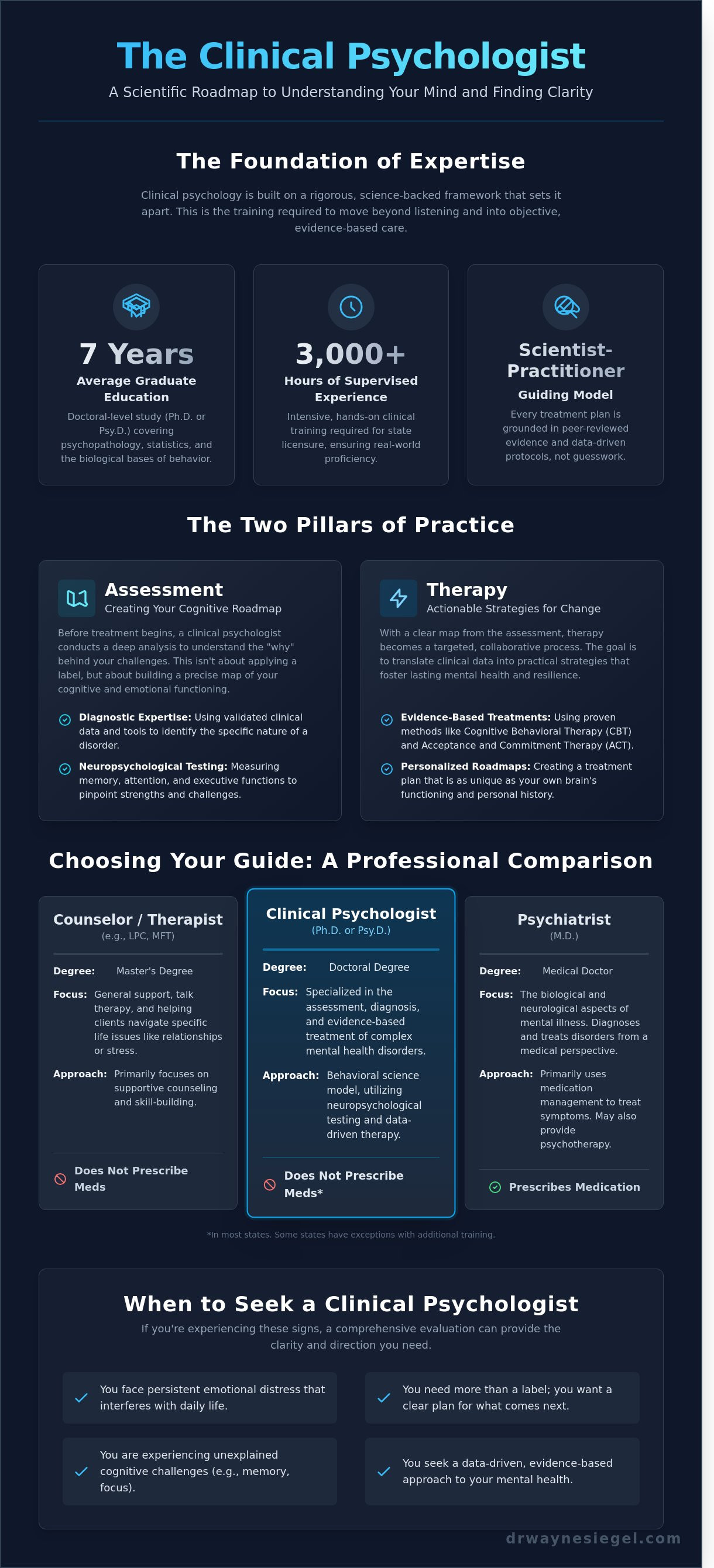
Psychologist vs. Psychiatrist vs. Counselor: Understanding the Differences
When you're facing a cognitive or emotional challenge, finding the right professional is the first step toward clarity. I often see patients who are confused by the various titles in the mental health field. The distinction between a psychiatrist, a psychologist, and a counselor isn't just about the letters after a name. It's about the fundamental philosophy of care and the depth of the diagnostic process. Understanding these differences helps you build a healthcare team that truly meets your needs.
Psychiatrists are medical doctors (MDs or DOs). They spend 12 or more years in school and residency to understand the biological drivers of mental illness. Their approach is primarily pharmacological; they prescribe medications to stabilize brain chemistry. While they're essential for managing severe chemical imbalances, they rarely provide the intensive, hour-long talk therapy sessions that many people associate with mental health care. Their focus is on the "what" of a condition from a medical perspective.
In contrast, what a clinical psychologist does involves a deep dive into the intersection of behavior, cognition, and emotion. We don't prescribe medication in most states. Instead, we use scientific research and standardized testing to uncover the "why" behind your symptoms. If you're wondering exactly what does a clinical psychologist do, think of us as the scientists of the mental health world. We use data to identify patterns and develop a precise roadmap for your recovery.
Counselors and Licensed Clinical Social Workers (LCSWs) typically hold a Master's degree, which involves about 2 years of graduate study. They provide vital support and are often excellent for navigating life transitions or social service systems. However, they generally lack the extensive training in psychological assessment and data interpretation that a doctoral-level psychologist possesses. Their work is often focused on general support and coping strategies rather than the intricate application of research-based interventions for persistent disorders.
When to Choose a Clinical Psychologist
You should seek a clinical psychologist when you need a definitive diagnosis or specialized testing. I recommend this path for deep, evidence-based psychotherapy to address trauma, ADHD, or persistent mood disorders that haven't responded to general counseling. Many of my patients maintain a collaborative care model; they see a psychiatrist for medication management while working with me for the structural, behavioral work of therapy. This ensures both the biological and psychological aspects of their health are addressed.
Training and Credential Comparison
The path to becoming a clinical psychologist is exceptionally rigorous. It requires a PhD or PsyD, which involves 4 to 7 years of post-undergraduate study. During this time, we're trained to interpret complex data and conduct original research. Most states require between 1,500 and 3,000 hours of supervised clinical experience before we're eligible for licensure. This contrasts with the 2 years of graduate school for counselors or the medical school focus of psychiatrists. This high level of specialization ensures that the care you receive is grounded in the latest scientific findings and a thorough understanding of human behavior.
- Psychiatrist: Medical Degree (MD/DO), focus on biology and medication.
- Clinical Psychologist: Doctorate (PhD/PsyD), focus on testing, research, and behavioral science.
- Counselor/Social Worker: Master's Degree (MA/MS/MSW), focus on general support and social systems.
When Should You Seek a Clinical Psychologist?
Deciding to seek professional help is a significant step toward personal clarity. I often tell my patients that you don't need to wait for a total breakdown to reach out. If your anxiety or low mood has persisted for more than 14 days and interferes with your ability to complete tasks at work or maintain harmony in your relationships, it's time to talk. Data from the American Psychological Association indicates that one in five adults experiences a mental health condition each year. I view my role as helping you decipher these emotional signals before they become overwhelming or chronic.
Cognitive struggles are another primary indicator that an evaluation is necessary. If you find yourself frequently losing focus, forgetting important appointments, or struggling with basic organization, you might be experiencing executive functioning deficits. These aren't merely personality quirks; they're often measurable cognitive patterns. A clinical psychologist can determine if these issues stem from ADHD, a specific learning disability, or high stress levels. By analyzing your unique cognitive profile, I help you create a roadmap that moves you from a state of confusion to one of focused competence.
Trauma and post-traumatic stress often require specialized care that goes beyond general support. According to the National Center for PTSD, about 6% of the U.S. population will have PTSD at some point in their lives. If past experiences continue to dictate your present sense of safety or well-yearning, expert intervention is essential. Similarly, navigating complex life transitions like a career change or a divorce can benefit from a neutral, expert guide. I provide a stable, non-judgmental environment where we can dissect these interpersonal dynamics and find a path forward together.
Common Signs That Expert Intervention is Needed
- Feeling "stuck": You've tried general counseling or self-help books without seeing measurable progress in your daily life.
- Somatic symptoms: You experience persistent headaches, digestive issues, or insomnia with no clear medical cause. Research suggests up to 33% of primary care visits involve these medically unexplained symptoms linked to psychological stress.
- A desire for structure: You want more than just a place to vent; you're looking for an evidence-based roadmap for recovery. Understanding what does a clinical psychologist do helps you see that we offer diagnostic-led strategies rather than open-ended conversation.
The Value of Early Intervention
Professional assessment is a powerful tool for prevention. A 2021 study published in The Lancet emphasized that early intervention in mental health significantly reduces long-term disability and improves overall quality of life. By identifying challenges early, we can build a toolkit of coping strategies that serve you for a lifetime. This proactive approach ensures that minor setbacks don't evolve into permanent roadblocks. Clinical intervention is a proactive investment in your future health rather than a reactive response to a crisis.
Finding Clarity: The Siegel Psychology Services Approach
Dr. Wayne Siegel provides a level of clinical authority that comes from over 25 years of dedicated practice. As a board-certified psychologist, he adheres to the rigorous standards set by the American Board of Professional Psychology. His commitment to evidence-based care means that every session is grounded in scientific reality. Understanding what does a clinical psychologist do starts with recognizing the value of these proven methods. He utilizes Cognitive Behavioral Therapy (CBT) and Acceptance and Commitment Therapy (ACT) to help patients achieve measurable improvements in their daily lives. Research indicates that these specific modalities can reduce symptoms of anxiety and depression by as much as 50 percent within the first 12 to 15 sessions when implemented with precision.
When exploring what does a clinical psychologist do, it's vital to recognize the role of objective, data-driven assessment. Dr. Siegel doesn't rely on guesswork; he analyzes clinical data to provide a roadmap for your future. This approach is accessible regardless of your location within the 40 plus PsyPact states. By offering telehealth across Minnesota and beyond, he removes the traditional barriers to expert care. This nationwide accessibility ensures that a high standard of psychological precision is available to those who need it most, regardless of their proximity to a physical office. The focus remains on the whole person, providing clarity through assessment rather than just treating a collection of symptoms.
Personalized, Person-Centered Evaluations
A diagnosis should be a doorway to understanding, not a box that limits your potential. Dr. Siegel’s evaluations move beyond surface-level labels to explore the unique "why" behind your specific challenges. His comprehensive ADHD and diagnostic assessments are tailored for the complexities of adult life. These evaluations often involve several hours of standardized testing to map out executive functioning and cognitive strengths. This is a non-judgmental, steady partnership built on integrity. By focusing on the whole person, Dr. Siegel identifies the cognitive and emotional patterns that influence your daily performance. This level of clinical precision ensures that the resulting roadmap is both accurate and actionable, helping you leverage your strengths while addressing your weaknesses in a practical way.
Next Steps: How to Get Started
Taking the first step toward mental clarity is a structured process designed to reduce anxiety. The intake process begins with a comprehensive 60-minute consultation. During this time, you'll discuss your history and current struggles in a safe, professional environment. If you're using online therapy for the first time, you'll find the PsyPact telehealth model offers both security and efficacy. We use encrypted platforms that meet all federal HIPAA standards to protect your sensitive information. Data from the American Psychological Association suggests that telehealth is just as effective as in-person visits for diagnostic purposes. This modern approach allows you to receive expert care from the comfort of your home. If you're ready to gain a clearer picture of your life, Schedule a consultation with Dr. Wayne Siegel today and begin the journey toward lasting insight.
Moving Toward Clarity and Evidence-Based Growth
Your journey toward mental wellness shouldn't be a guessing game. By choosing evidence-based care, you ensure that every step of your treatment is grounded in 2026 clinical standards and proven scientific research. Understanding what does a clinical psychologist do empowers you to distinguish between general support and the specialized diagnostic assessments required for complex cognitive profiles. I've spent over 25 years refining this process to help patients move from confusion to a clear roadmap for their daily lives. It's about more than labels; it's about finding actionable meaning through data.
As a practitioner Board-Certified by the American Board of Professional Psychology (ABPP), I provide a level of expertise that prioritizes clinical integrity. We can connect through telehealth services available in all 40 plus PsyPact states, ensuring you receive high-quality care regardless of your physical location. This structured approach helps lower the anxiety of the unknown by providing a steady, non-judgmental guide through your cognitive landscape. You're an individual who deserves a precise and compassionate plan for improvement.
Gain clarity and insight; contact Siegel Psychology Services for a consultation today.
You don't have to navigate these complex questions alone; expert guidance is ready when you are.
Frequently Asked Questions
Is a clinical psychologist the same as a therapist?
Therapist is a broad term, but a clinical psychologist holds a doctoral degree and completes at least 3,000 hours of supervised clinical training. I focus on evidence-based practices like Cognitive Behavioral Therapy, which has over 2,000 outcome studies supporting its efficacy. This advanced training allows me to provide a deeper level of diagnostic clarity than providers with master's level education. It ensures your care is grounded in rigorous science.
Can a clinical psychologist prescribe medication?
In 45 of 50 U.S. states, clinical psychologists don't prescribe medication. I work closely with your physician to coordinate care if pharmacological intervention is necessary. Currently, only five states allow psychologists with specialized post-doctoral training to write prescriptions. My role focuses on the why behind your symptoms through comprehensive assessment and psychotherapy. This partnership helps us create a stable roadmap for your recovery and long-term well-being.
What happens during a psychological evaluation?
A psychological evaluation is a structured process involving clinical interviews and standardized testing to create a cognitive profile. I typically spend 4 to 6 hours administering validated instruments like the WAIS-IV or MMPI-3. These tests provide objective data on your executive functioning and emotional state. The goal is to move beyond labels to find actionable meaning, resulting in a roadmap for your specific treatment journey and providing much-needed clarity.
Do clinical psychologists treat serious mental illness?
Yes, clinical psychologists are specifically trained to treat complex conditions like schizophrenia or bipolar I disorder. Research from the National Institute of Mental Health shows that combining medication with specialized therapy reduces relapse rates by 50 percent. I utilize evidence-based protocols to help patients manage symptoms and improve their daily quality of life. This approach provides a sense of safety and stability while navigating complex emotional and cognitive landscapes.
How long does therapy with a clinical psychologist usually last?
The duration of therapy varies, but evidence-based protocols for anxiety often span 12 to 20 weekly sessions. According to the American Psychological Association, 50 percent of patients show significant improvement after 15 to 22 sessions. I track your progress using objective measures to ensure our work remains focused. We'll regularly review your goals to determine if long-term support or a shorter, solution-focused approach is best for your unique needs.
What is the difference between a PhD and a PsyD in psychology?
A PhD focuses on a balance of research and clinical practice, while a PsyD emphasizes direct clinical application. Both degrees require 5 to 7 years of graduate study and a 1-year full-time internship. When you ask what does a clinical psychologist do, the answer involves high-level diagnostic skills regardless of the degree type. I use my doctoral training to analyze complex data and provide the clarity you need to move forward.
Is online therapy with a clinical psychologist effective?
Yes, a 2018 study published in the Journal of Anxiety Disorders found that internet-delivered CBT is just as effective as face-to-face treatment for major depression. I offer secure, HIPAA-compliant telehealth sessions that maintain the same rigorous clinical standards as an in-office visit. This format provides a safe, accessible way to begin your journey toward better mental health. It's an effective option for those seeking professional care from the comfort of home.
What is a Board-Certified Clinical Psychologist?
Board certification through the American Board of Professional Psychology represents the highest level of specialty certification in the field. Only about 4 percent of licensed psychologists hold this credential, which requires a rigorous peer-review process and an oral examination. It demonstrates my commitment to excellence and ensures I'm providing care that meets the most stringent national standards. This certification offers you peace of mind regarding the technical proficiency and ethics of your care.