
The Clinical and Privacy Benefits of Private Pay Psychotherapy: A 2026 Guide

What if the insurance card in your wallet is actually the primary obstacle to your clinical privacy and long-term recovery? You likely feel that health coverage should simplify your path to wellness, yet 2024 research from the National Alliance on Mental Illness shows that patients are over twice as likely to face out-of-network barriers for mental health than for physical health. It's frustrating when a third-party payer requires a permanent mental health diagnosis on your medical record just to authorize a few sessions. Understanding the benefits of private pay psychotherapy allows you to bypass these systemic constraints and reclaim control over your personal health data.
This 2026 guide explains how opting out of the insurance model protects your confidentiality and ensures your treatment is guided by clinical evidence rather than corporate bottom lines. I'll help you discover how private pay provides the freedom to use specialized protocols like ACT or CBT without arbitrary time limits. We'll examine the roadmap to accessing board-certified expertise and achieving a higher standard of care that prioritizes your unique cognitive profile and daily quality of life.
Key Takeaways
- Learn how a direct-pay model ensures your clinical records remain strictly confidential between you and your doctor, bypassing the data-sharing requirements of insurance companies.
- Discover how the benefits of private pay psychotherapy allow for evidence-based treatments like CBT and ACT to be tailored to your unique needs rather than dictated by managed care mandates.
- Understand why removing third-party interference strengthens the therapeutic alliance, which research consistently identifies as the primary predictor of successful clinical outcomes.
- Explore practical strategies for utilizing Out-of-Network (OON) benefits and Health Savings Accounts (HSAs) to maintain high-quality care while managing your financial investment.
- Gain clarity on how a board-certified, person-centered approach provides a roadmap for your mental health journey without the constraints of "medical necessity" labels.
Beyond the Copay: Understanding the Structural Constraints of Insurance-Based Care
Choosing a therapist is a deeply personal decision that often begins with a simple question: "Does my insurance cover this?" While using a health plan seems logical, it introduces a third party into our professional relationship. Private pay psychotherapy, often called the self-pay model, is a direct contract between you and your doctor. This model removes the administrative oversight that frequently dictates the pace and nature of your healing. One of the primary benefits of private pay psychotherapy is the restoration of your clinical autonomy, ensuring that your goals, not an actuary’s spreadsheet, guide our work together.
Insurance companies operate under a "Medical Necessity" mandate. This means they only reimburse for services that treat a recognized illness. This framework often prioritizes rapid stabilization over the comprehensive psychological growth or the deep clarity you're seeking. When a third party enters the room, the clinical focus shifts from your long-term well-being to short-term symptom management. This interference can disrupt the therapeutic flow and limit our ability to address the underlying "why" behind your challenges. I've found that true insight requires a space free from these external pressures.
The "Medical Necessity" Trap
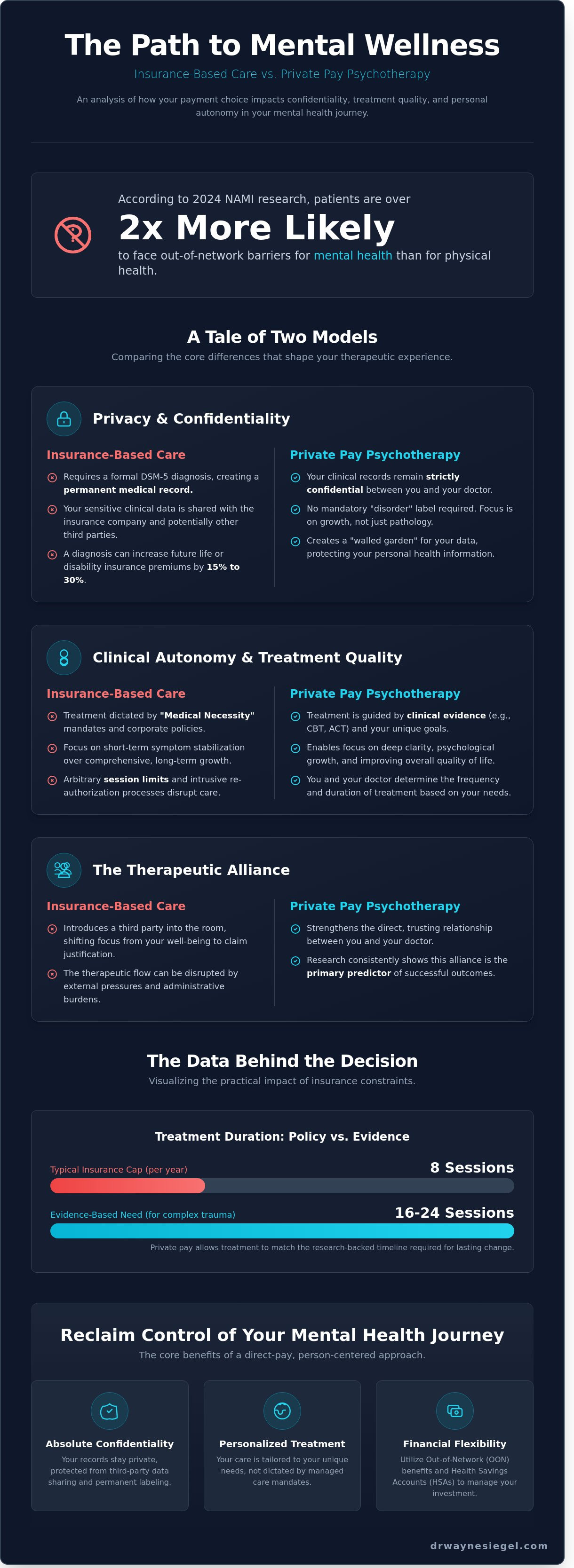
To process a claim, insurance companies require a formal diagnosis from the DSM-5, the diagnostic manual updated in 2013. This requirement creates a permanent medical record of a mental health disorder. In some cases, this leads to "up-coding," where a provider might feel pressured to assign a more severe diagnosis just to ensure the company pays for the visit. This label doesn't just stay in my office; it follows you. A formal diagnosis can increase life insurance or disability premiums by 15% to 30% depending on the severity of the code. By opting for private pay, we protect the principle of confidentiality and keep your personal growth separate from your permanent medical history.
Session Limits and Treatment Duration
Under managed care, an insurance adjuster often decides when your treatment is finished. This creates a fundamental conflict between standardized "caps" and personalized, evidence-based recovery. For example, while research suggests that complex trauma may require 16 to 24 sessions for significant improvement, some plans limit coverage to just 8 sessions per calendar year. The stress of "re-authorization" requires me to submit your private progress notes to a reviewer to justify more time. This process is intrusive and can derail the steady, deliberate rhythm we've established. One of the significant benefits of private pay psychotherapy is that it allows us to build a roadmap based on your unique cognitive profile rather than a rigid corporate policy.
- Direct Access: You choose the frequency and duration of your appointments without external caps.
- Diagnostic Privacy: We focus on your strengths and challenges without the need for a permanent "disorder" label.
- Evidence-Based Pacing: We follow the research-backed timeline your specific situation requires for lasting change.
I believe every person deserves a safe, quiet space to explore their life without the pressure of a ticking clock or a third-party monitor. Our partnership is built on integrity and a commitment to uncovering the truth of your experience. By stepping outside the insurance system, we ensure that your journey toward clarity remains entirely in your hands. This approach allows us to treat the whole person, focusing on improving your daily quality of life rather than just checking boxes for a claim form.
The Clinical Record: Privacy and Data Security in Private Practice
Privacy is the bedrock of a successful therapeutic alliance. When you pay out of pocket, you create a direct agreement that limits the distribution of your sensitive information. One of the primary benefits of private pay psychotherapy is the creation of a "walled garden" for your clinical records. In this model, your diagnostic history and session notes don't enter the massive, interconnected databases managed by third-party payers. This internal-only documentation strategy ensures that your personal narrative remains exactly where it belongs; between you and your clinician. Understanding the benefits of private pay psychotherapy requires looking at the digital footprint left behind by traditional insurance claims.
Who Has Access to Your Mental Health Data?
Insurance companies don't just pay bills. They frequently exercise their right to audit clinical files to verify that treatment meets their specific, often rigid, criteria for medical necessity. This means a claims adjuster or a peer reviewer, individuals you've never met, may read detailed accounts of your sessions. While HIPAA's strict privacy rules provide a baseline of protection, they also permit insurance companies to review your records for quality of care or medical necessity audits. Modern Electronic Health Records (EHR) often connect to regional health information exchanges. If your therapist is in-network, your mental health diagnosis might automatically populate in a general medical portal accessible by your primary care physician or even an urgent care doctor. A private practice operating outside these networks keeps your data siloed and secure. This prevents your mental health history from becoming a permanent, visible part of your general medical file unless you explicitly choose to share it.
- Data Control: You decide who sees your records, rather than an insurance algorithm.
- Reduced Breach Risk: Smaller, private databases are less attractive targets for large-scale cyberattacks.
- Audit Immunity: Your session notes aren't subject to review by corporate insurance adjusters.
The Implications for Professional Licensure and Security Clearances
For professionals in high-stakes fields, a permanent mental health diagnosis in a centralized database carries tangible risks. Pilots, surgeons, and individuals requiring high-level security clearances often face rigorous scrutiny regarding their cognitive and emotional health. In 2023, the HHS Office for Civil Rights reported 725 large-scale healthcare data breaches, exposing the records of over 133 million individuals. This staggering number highlights the vulnerability of massive insurance databases. By choosing private pay, you can often frame your sessions as "consultation" or "personal growth" rather than a pathologized medical necessity required for insurance reimbursement. This distinction is vital; it allows you to seek support without triggering a mandatory report or a permanent "pre-existing condition" label in an insurance file.
I'm committed to meticulous, person-centered documentation that reflects your unique journey. My goal is to provide a roadmap for your well-being that prioritizes your future and your professional standing. Finding clarity through a private assessment allows you to maintain this control. We focus on your strengths and your specific cognitive profile, ensuring that the documentation serves your growth rather than a corporate algorithm. This approach provides a level of security and professional safety that insurance-based care simply can't match. It's an investment in your peace of mind and your long-term career stability.
Clinical Autonomy: Why Evidence-Based Treatment Thrives Outside Managed Care
Research consistently identifies the therapeutic alliance as the most significant predictor of patient success. A study published in the journal Psychotherapy found that the quality of the relationship between therapist and client accounts for roughly 30% of the variance in treatment outcomes. When we remove the constraints of managed care, we create a space where this alliance can flourish. One of the core benefits of private pay psychotherapy is the shift in accountability; my primary responsibility remains with you, not a corporate bottom line. This autonomy allows us to focus on your specific roadmap to clarity without the interference of third-party administrators who often prioritize cost-cutting over clinical depth.
Operating outside the insurance model also directly impacts the quality of care by mitigating clinician burnout. In a 2022 American Psychological Association survey, 45% of psychologists reported feeling burned out, often due to the high caseloads required to sustain an insurance-based practice. By choosing a private pay model, I intentionally maintain a smaller, more focused caseload. This ensures I can dedicate the necessary intellectual energy and emotional presence to every individual I see. You aren't just another number in a crowded waiting room; you're a unique person whose cognitive and emotional landscape deserves meticulous attention.
Tailoring CBT and ACT to Your Specific Needs
Evidence-based protocols like Cognitive Behavioral Therapy (CBT) and Acceptance and Commitment Therapy (ACT) aren't rigid scripts. They're flexible frameworks that require precise adjustment. In a private pay setting, we aren't limited to the standard 45-minute "clinical hour" if a case's complexity demands more time. I have the freedom to integrate comprehensive psychological testing into our sessions, providing a data-driven foundation that informs every step of your journey. This flexibility ensures that we're treating the whole person rather than just checking boxes on an insurance form.
The Specialist Advantage
Highly specialized care often exists outside the traditional insurance grid. Only about 4% to 5% of licensed psychologists in the United States hold board certification, a credential that signifies a rigorous level of peer-reviewed expertise. Experts with this level of training, particularly in niche areas like neuropsychological evaluations or ADHD, frequently opt for private pay to maintain the integrity of their diagnostic process. This model also expands your options through PsyPact, which currently allows me to provide telehealth services to patients in 40+ states. You gain access to national-level expertise and a clear, actionable path forward, regardless of your local provider landscape.
Choosing this path is an investment in a partnership built on transparency and clinical rigor. It's about moving beyond mere symptom management to find the "why" behind your challenges. When we work together in this capacity, we're focused on improving your daily quality of life through a process that's as compassionate as it is scientifically sound. We'll work at a pace that feels respectful and attentive, ensuring you feel heard and supported throughout the entire diagnostic and treatment process.
Navigating the Financial Landscape: OON Reimbursement and HSA Strategies
Choosing private pay doesn't require you to abandon your insurance coverage entirely. It's a common misconception that these two paths are mutually exclusive. One of the primary benefits of private pay psychotherapy is the ability to maintain clinical autonomy while still accessing financial relief through Out-of-Network (OON) benefits. Data from a 2019 Milliman report indicates that patients are 5.4 times more likely to seek behavioral health services out-of-network compared to surgical or medical care. This reality has led to a streamlined process for reimbursement that many of my patients find manageable and effective.
I view the cost of therapy as a strategic investment in your cognitive and emotional clarity. Research published in the Journal of Clinical Psychiatry estimated the economic burden of untreated major depressive disorder at $210.5 billion annually in the United States. This figure includes lost productivity and physical health complications. By prioritizing high-quality, specialized care now, you're actively mitigating the risk of much higher long-term costs to your health and career.
How to Use Your Out-of-Network Benefits
Most PPO insurance plans offer OON coverage, often reimbursing between 60% and 80% of the "allowed amount." To gain clarity on your specific plan, I recommend calling the member services number on your insurance card and asking these three specific questions:
- Does my plan cover CPT code 90837 (60-minute individual psychotherapy) for out-of-network providers?
- What is my out-of-network deductible, and how much of it has been met this year?
- What is the "allowable amount" the plan pays for a 90837 session in my zip code?
The difference between the "billed amount" and the "allowed amount" is crucial. If a session costs $225 and your insurance allows $180, your 70% reimbursement will be calculated based on the $180 figure. I provide my patients with a "Superbill" at the end of each month. This document contains all the necessary diagnostic and procedural codes your insurer needs to process your claim directly.
HSA and FSA: Tax-Advantaged Therapy
Using a Health Savings Account (HSA) or a Flexible Spending Account (FSA) is one of the most effective ways to lower the cost of care. These accounts allow you to pay for therapy with pre-tax dollars. According to IRS Publication 502, mental health services provided by psychologists and licensed therapists are qualifying medical expenses. If you're in a 24% federal tax bracket, using an HSA effectively gives you a 24% discount on every session.
In my practice, using these accounts is as simple as using a standard debit card. Most HSA and FSA providers issue a card that we can keep on file for seamless payments. This removes the friction of manual reimbursement and ensures your therapy budget is set aside specifically for your well-being. It's a disciplined, tax-efficient way to ensure the benefits of private pay psychotherapy remain accessible while you work toward lasting emotional stability.
If you're ready to gain a clearer roadmap for your mental health journey, I invite you to schedule a consultation to discuss your specific needs.
Expert-Led Care in Minneapolis and Beyond: The Siegel Psychology Approach
Dr. Wayne Siegel provides a clinical environment where rigorous science meets deep, person-centered empathy. With over 25 years of experience, he leads Siegel Psychology Services, holding board certification through the American Board of Professional Psychology (ABPP). This distinction is held by approximately 4% of psychologists nationwide, signifying a commitment to the highest standards of evidence-based care. His philosophy isn't rooted in a one-size-fits-all model. Instead, it's a partnership designed to uncover the specific mechanisms behind your daily challenges. By operating outside the constraints of traditional insurance, Dr. Siegel ensures that your care is dictated by clinical necessity and your personal goals, not by corporate billing requirements.
One of the primary benefits of private pay psychotherapy is the ability to bypass the restrictive oversight of insurance companies. This model allows for a more focused, intensive approach to healing. It creates space for a clinical roadmap that prioritizes clarity and actionable results. You aren't just a diagnosis on a claim form; you're an individual seeking a path forward. Dr. Siegel uses his extensive background to guide you through complex cognitive and emotional landscapes with a steady, non-judgmental hand. This results in a therapeutic process that is as efficient as it's profound.
Comprehensive Assessment Meets Personalized Therapy
Effective treatment begins with an accurate map. Dr. Siegel’s expertise in ADHD and neuropsychological diagnostic evaluations allows him to see the "why" behind your struggles. Many patients find that their therapy stalled in the past because the underlying cognitive profile wasn
Securing Your Roadmap to Lasting Clarity
Choosing a therapeutic path involves balancing immediate costs with long term clinical outcomes. By prioritizing the benefits of private pay psychotherapy, you secure a level of diagnostic privacy and treatment flexibility that managed care often restricts. My practice focuses on providing this clarity through evidence-based CBT and ACT protocols. This ensures your care is driven by clinical needs rather than administrative quotas. I bring over 25 years of experience as a Board-Certified Clinical Psychologist to every session to help you build a roadmap toward measurable change.
Whether we meet in my Minneapolis office or via telehealth across 40 plus PsyPact states, our work remains focused on your specific goals. You deserve a partnership that values your data security and your personal progress above all else. I'm here to help you navigate this journey with precision and care. It's a process built on trust and clinical excellence.
Begin your journey toward clarity; schedule a consultation with Dr. Siegel
You have the strength to take this next step, and I look forward to supporting your growth.
Frequently Asked Questions
Is private pay therapy more expensive than using insurance in the long run?
Private pay therapy can be more cost-effective because it removes insurance-mandated limits on session frequency and duration. Research published in the Journal of Psychological Services in 2021 suggests that specialized, evidence-based care often results in 15% faster symptom reduction compared to generalized care. By focusing on quality and specific expertise, you may require fewer total sessions to reach your goals. This efficiency often offsets the initial higher per-session cost.
Can I still get reimbursed by my insurance if I see a private pay therapist?
You can often receive reimbursement for 50% to 80% of session costs if your plan includes out-of-network benefits. One of the primary benefits of private pay psychotherapy is the ability to choose a specialist while still utilizing your insurance's out-of-network provision. You'll pay the therapist directly at the time of service and then submit a claim to your carrier. Most major insurers process these claims within 14 to 30 days.
Does a private pay therapist still have to give me a diagnosis?
Private pay therapists aren't required to submit a formal mental health diagnosis to your insurance company. This is a significant advantage for individuals concerned about their permanent medical record. According to a 2019 survey by the American Psychological Association, 42% of practitioners noted that avoiding a diagnosis can help patients avoid potential stigma in future life insurance applications. We focus on your unique cognitive profile rather than a rigid label.
What is a Superbill, and how do I use it for therapy?
A Superbill is a specialized document that lists the specific services you received, such as CPT code 90837 for a 60-minute session. It includes the therapist’s NPI number, tax ID, and a diagnosis code if you choose to report one. To use it, you simply upload the document to your insurance provider’s member portal. This allows the insurer to track your spending toward your out-of-network deductible and issue a reimbursement check.
Why do many board-certified psychologists not take insurance?
Many specialists opt out of insurance panels to maintain a higher standard of individualized care and clinical autonomy. A 2022 report from the American Psychological Association indicated that 30% of psychologists don't accept insurance due to administrative burdens and low reimbursement rates. One of the benefits of private pay psychotherapy is that it allows me to spend more time on your specific case and research rather than on paperwork.
Will my therapy records be shared with my employer if I use private pay?
Your therapy records remain entirely confidential and won't be shared with your employer when you pay privately. Under the HIPAA Privacy Rule, specifically 45 CFR § 164.502, your health information is protected from unauthorized disclosure. When you bypass the insurance claims process, your employer’s HR department never receives notification of your treatment or diagnosis. This provides a secure environment where you can explore challenges without any professional repercussions.
How do I know if my insurance offers out-of-network benefits?
You can determine your coverage by reviewing the Out-of-Network section of your Summary of Benefits and Coverage document. Look specifically for your OON Deductible and Coinsurance percentage. For example, a common plan might cover 70% of the allowed amount after you meet a $2,000 deductible. I recommend calling the number on the back of your card and asking specifically about reimbursement for CPT codes 90791 or 90837.
Can I use my HSA or FSA to pay for psychological testing and assessments?
You can use your Health Savings Account (HSA) or Flexible Spending Account (FSA) to pay for all psychological testing and therapy services. IRS Publication 502 explicitly lists psychiatric care and psychological clinical services as eligible medical expenses. Using these pre-tax dollars can effectively reduce your out-of-pocket costs by 20% to 30%, depending on your tax bracket. It’s a practical way to invest in the clarity and roadmap that a comprehensive assessment provides.