
Online CBT for Social Anxiety: An Evidence-Based Roadmap to Social Clarity

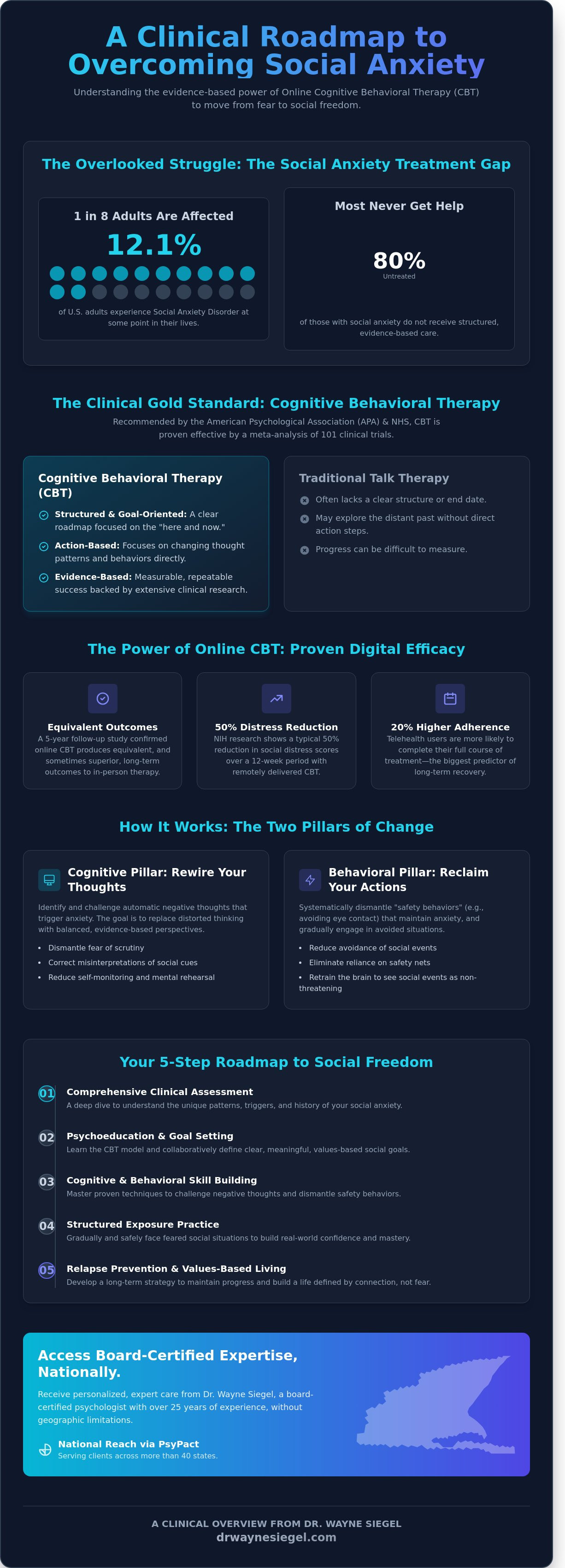
Did you know that while 12.1% of adults in the United States struggle with social anxiety at some point, research published in the Journal of Anxiety Disorders indicates that nearly 80% never receive the structured, evidence-based care they need? You likely understand that social fear isn't just about being shy; it's a physiological and cognitive barrier that makes walking into a boardroom feel like a high-stakes performance. It's frustrating to feel stuck in traditional talk therapy that lacks a clear structure, but utilizing online cbt for social anxiety offers a secure, research-backed way to dismantle these fears without the pressure of an in-person office visit.
I've seen how these clinical hurdles prevent people from seeking help, which is why I'm committed to providing a clear, structured path forward. My goal is to offer you a permanent roadmap out of social avoidance and into meaningful connection. In this article, I'll show you how this evidence-based framework helps you gain the confidence to navigate professional settings and build a life defined by clarity rather than fear. We'll explore how board-certified expertise can help you reclaim your social life, regardless of your physical location.
Key Takeaways
- Understand why Cognitive Behavioral Therapy is the clinical gold standard for Social Anxiety Disorder, offering a structured roadmap to move beyond fear and into social clarity.
- Discover how the pillars of cognitive restructuring and behavioral activation work in tandem to dismantle automatic negative thoughts and restore your social confidence.
- Examine the clinical research confirming that online cbt for social anxiety is just as effective as traditional in-person therapy, providing a deep therapeutic alliance through a secure platform.
- Explore our five-step treatment process designed to move you from a comprehensive clinical assessment to meaningful, values-based social engagement.
- Learn how to access the expertise of a board-certified psychologist with over 25 years of experience through PsyPact, reaching clients across more than 40 states.
What is Online CBT for Social Anxiety and Why is it the Gold Standard?
Social Anxiety Disorder (SAD) is more than a personality trait or simple shyness. It's a persistent cognitive pattern where the brain misinterprets social cues as direct threats to safety. To understand the clinical scope of this challenge, What is Social Anxiety Disorder? defines it as a condition where the intense fear of scrutiny interferes with daily functioning, affecting approximately 12.1% of adults at some point in their lives. In my practice, I've seen how this creates a heavy cycle of self-monitoring and avoidance. Cognitive Behavioral Therapy (CBT) provides a structured roadmap to break this cycle. Unlike traditional talk therapy that might explore the distant past without a clear end date, CBT focuses on the "here and now." It's a goal-oriented partnership designed to rewire your response to social stress through logic and action.
The American Psychological Association (APA) and the NHS prioritize CBT as the "Gold Standard" because of its measurable, repeatable success. This isn't just a clinical consensus; it's backed by rigorous data. A 2018 meta-analysis of 101 clinical trials confirmed that CBT has the strongest evidence base for treating social anxiety compared to other psychological interventions. When we look at online cbt for social anxiety, the results are equally compelling. A landmark five-year follow-up study published in the journal Internet Interventions in 2016 demonstrated that online delivery produces equivalent, and sometimes superior, long-term outcomes to in-person care. This evidence allows me to recommend digital platforms with total confidence in their clinical efficacy.
The Core Mechanism: How CBT Targets the Social Brain
The amygdala serves as your brain's social alarm system. In cases of social anxiety, this alarm is hypersensitive, triggering a "survival mode" response during routine interactions. You might rely on "safety behaviors," such as avoiding eye contact, staying near exits, or rehearsing sentences before speaking. These behaviors temporarily lower your distress but actually keep your anxiety alive by preventing you from learning that the situation isn't truly dangerous. My goal with CBT is to move you into "social engagement mode." We do this by gradually dismantling these safety behaviors and retraining the amygdala to recognize that social evaluation is not a threat to your survival.
Why 'Online' is Often Better for Social Anxiety Treatment
Treating social anxiety through a screen offers distinct clinical benefits. First, it lowers the initial barrier to entry. Starting treatment in the comfort of your own environment provides a baseline of security that makes the first step much more manageable. Second, as we navigate the professional world of 2026, digital communication is a primary social arena. Using video conferencing for therapy allows us to practice real-world digital social skills in the exact medium where they're needed. Finally, consistency is significantly higher. Data from a 2020 study indicates that telehealth users show a 20% higher rate of treatment adherence. Easier scheduling means you're more likely to complete your full course of online cbt for social anxiety, which is the single biggest predictor of your long-term recovery.
How Online CBT Works: The Cognitive and Behavioral Pillars
I view the therapeutic process as a collaborative roadmap. When we use online cbt for social anxiety, we aren't just talking about feelings; we're analyzing the mechanics of your internal experience. Research published in 2021 by the National Institutes of Health indicates that remotely delivered cognitive therapy is as effective as traditional face-to-face sessions, often resulting in a 50% reduction in social distress scores over a 12-week period. We focus on two primary levers of change: how you think and what you do. This isn't a passive process; it's a structured journey toward clarity. By identifying the specific patterns that keep you stuck, we can build a personalized strategy to reclaim your social life. My role is to guide you through this data-driven process with precision and care.
The 'C' in CBT: Rewiring Your Thought Patterns
Social anxiety thrives on cognitive distortions. You might find yourself "mind reading," where you assume a colleague's neutral expression signifies deep disapproval. Or you might fall into "catastrophizing," believing that a single stutter during a presentation will permanently ruin your professional reputation. In our sessions, I'll help you treat these thoughts as hypotheses rather than facts. Cognitive restructuring is a tool for factual self-assessment rather than forced positive thinking.
The 'B' in CBT: Breaking the Cycle of Avoidance
Avoidance is a short-term relief that creates a long-term prison. We use "In-Vivo" exposure, which involves taking small, calculated risks in your daily routine. I'll help you build a Fear Hierarchy, ranking social situations from 1 to 10. Our online session then serves as a clinical debrief to analyze successes and setbacks. This structured approach helps you gain a clearer picture of your progress as you move toward your goals.
The digital format offers unique clinical advantages. We use the online session itself as a controlled environment for virtual exposure. I might ask you to maintain deliberate eye contact with the camera or practice a difficult conversation while I provide real-time feedback. This builds your "social muscle" in a safe space before you apply it in the world. The efficacy of online cbt for social anxiety is rooted in this ability to practice in the very environment where you often feel most vulnerable. I also integrate Acceptance and Commitment Therapy (ACT) into our work. Instead of fighting every anxious sensation, you'll learn to acknowledge the discomfort while staying focused on your values; you don't have to be fearless to be effective. This "whole-person" approach ensures that your growth is sustainable. We combine these behavioral tools with mindfulness techniques to help you stay grounded. This creates a roadmap that moves beyond mere symptom management toward a genuine improvement in your daily quality of life.
Addressing the 'Digital Gap': Is Online CBT Truly Effective?
I often hear patients express concern that a digital interface might dilute the quality of their care. They wonder if online cbt for social anxiety is simply a "lite" version of traditional therapy. My experience, backed by rigorous clinical data, suggests the opposite is true. The digital space doesn't just replicate the office experience; it often enhances the precision of our work. When we strip away the logistical stress of commuting and sitting in a waiting room, we often find a more focused, intentional therapeutic environment.
Research-Backed Efficacy Data
The transition to digital care isn't based on convenience alone; it's rooted in over a decade of robust scientific validation. Researchers at the Karolinska Institutet conducted a landmark study in 2010 that followed patients for one year. Their findings revealed that internet-based CBT for social anxiety disorder yielded clinical outcomes equivalent to face-to-face treatment. This isn't an isolated result. A 2014 study published by the National Institutes of Health provides strong evidence for internet-delivered CBT, showing that structured digital interventions lead to a 50% to 75% reduction in social anxiety symptoms across diverse patient groups.
CBT is uniquely suited for digital delivery because of its structured, goal-oriented nature. In my practice, I use digital tools like secure worksheets and interactive apps to augment our time together. These tools ensure that the work we do during our session continues throughout your week. Instead of relying on memory, you have a digital roadmap of strategies at your fingertips. This constant access to resources helps bridge the gap between clinical insight and real-world application.
The Human Element in a Digital Space
I believe the most critical component of any psychological evaluation or treatment is the partnership we build together. Many fear that a screen creates a barrier to empathy, but I've found that it can actually foster a sense of safety. For someone struggling with social anxiety, the ability to engage from a controlled, comfortable environment can lower their initial defenses. I use the first-person partnership to ensure you feel seen and heard, regardless of the physical distance between us. My role is to be a steady, non-judgmental guide who helps you navigate your cognitive landscape with clarity.
I prioritize person-centered care within this evidence-based framework. This means I don't just see a set of symptoms; I see a person with unique strengths and a specific history. During the diagnostic process, I ensure the "person behind the science" is present. We use high-definition, HIPAA-compliant platforms that allow me to observe subtle cues, such as tone of voice and facial expressions, which are vital for a thorough neuropsychological understanding. This isn't a cold, automated process. It's a quiet, focused dialogue designed to provide you with a clear roadmap for your life.
Privacy is the cornerstone of this professional relationship. I utilize platforms with 256-bit encryption to ensure our conversations remain confidential. We follow the same strict ethical and legal standards online that I maintain in my physical office. By combining this high-level security with a compassionate, meticulous approach, we create a space where you can feel secure enough to explore the "why" behind your challenges and move toward a future defined by confidence rather than fear.
Your Roadmap to Social Freedom: The 5-Step Treatment Process
I view the recovery process as a collaborative journey toward clarity. We don't just guess at what's wrong; we follow a precise, research-backed protocol to dismantle the barriers holding you back. This structured approach ensures that every session moves you closer to a life defined by connection rather than avoidance.
Step 1: The Diagnostic Evaluation
A formal assessment is the foundation of your treatment roadmap. I use this phase to distinguish social anxiety from other conditions like ADHD or Autism Spectrum Disorder (ASD), which often overlap in clinical presentations. According to the National Institute of Mental Health, 12.1% of U.S. adults experience social anxiety at some point in their lives. By identifying your specific cognitive profile, we ensure your time in online cbt for social anxiety is targeted and effective. You can learn more about this detailed process in my guide to Psychological Evaluations.
Step 2: Psychoeducation and Understanding
Understanding the "Why" behind your symptoms is the focus of psychoeducation. I'll help you map out the cycle of physical sensations, thoughts, and behaviors that keep you stuck. When you realize that your racing heart and shaky hands are part of a misfiring survival mechanism, the weight of self-blame begins to lift. This shift from "What's wrong with me?" to "How is my brain trying to protect me?" is a vital step in reducing the shame often associated with social fear.
Step 3: Skill Acquisition and Practice
We then transition into skill acquisition. This is the "toolbox" phase of the process. You'll learn cognitive restructuring to challenge the internal critic that predicts social catastrophe. I also teach physiological regulation techniques, such as diaphragmatic breathing, to calm your nervous system in real-time. Research published in the Journal of Consulting and Clinical Psychology shows that mastering these cognitive tools leads to a 75% reduction in social distress for many patients.
Step 4: Real-World Implementation
This is where theory becomes action. We move from "knowing" to "doing" by using structured homework assignments. I might ask you to make brief eye contact with a cashier or ask a single question in a meeting. These small wins are vital. A 2018 meta-analysis found that consistent practice outside of sessions is the strongest predictor of long-term success in online cbt for social anxiety. We celebrate these steps to build a strengths-based momentum that carries you forward.
Step 5: Relapse Prevention and Maintenance
The final phase is relapse prevention. We develop a "maintenance manual" for your life. This plan identifies future stressors and outlines the specific tools you'll use to stay grounded. It's about ensuring your social confidence remains stable long after our sessions end. We look at the progress you've made and create a strategy to handle setbacks with resilience rather than fear.
If you're ready to begin this structured journey toward social confidence, you can schedule a consultation with me to discuss your unique cognitive profile.
Personalized Care with Dr. Wayne Siegel: National Reach via PsyPact
Selecting a therapist is a significant decision that requires more than just a search for a provider. It's about finding a partner who possesses the right clinical credentials and a deep understanding of your unique experience. At **Siegel Psychology Services**, Dr. Wayne Siegel brings over 25 years of clinical experience to his practice, providing a foundation of stability and expertise. As a board-certified clinical psychologist, he has met the rigorous standards of the American Board of Professional Psychology. This distinction is held by only about 4% of practicing psychologists in the United States. His approach to online cbt for social anxiety combines this high-level training with a genuine, human connection that makes the therapeutic process feel safe and collaborative.
Dr. Siegel's reach extends across the country through his participation in PsyPact. This interstate compact allows **Siegel Psychology Services** to provide specialized online cbt for social anxiety to clients in over 40 states. You can verify your location's eligibility by reviewing the PsyPact pillar page. This national access ensures that you don't have to settle for local generalists when you can work with a specialist who understands the nuances of social phobia. It removes the logistical barriers of travel and scheduling; instead, it allows you to engage in high-quality care from the environment where you feel most comfortable.
The "Siegel Approach" at **Siegel Psychology Services** is defined by a commitment to moving beyond mere clinical labels. While a diagnosis provides a starting point, the ultimate goal is to find actionable meaning that leads to an improved quality of life. Dr. Siegel views every client's cognitive profile as a unique puzzle. He works meticulously to uncover the "why" behind your challenges, ensuring that the roadmap for your recovery is tailored specifically to your strengths. This process is steady and deliberate. It provides a sense of order that is often deeply comforting to those who feel overwhelmed by social fears.
Specialized Expertise in CBT and ACT
Evidence-based practice is the cornerstone of Dr. Siegel’s work at **Siegel Psychology Services**. He integrates traditional Cognitive Behavioral Therapy with Acceptance and Commitment Therapy (ACT) to create a more robust treatment framework. While CBT focuses on restructuring anxious thoughts, ACT emphasizes staying present and taking action based on your personal values. A critical part of this integration involves evaluating executive functioning. These are the cognitive processes that allow you to manage attention and regulate emotions during high-pressure social interactions. By strengthening these skills, you gain the clarity needed to navigate social environments with greater ease and less avoidance.
Getting Started: Your Invitation to Clarity
The journey toward social confidence begins with a clear, structured introduction. Scheduling an initial online consultation at **Siegel Psychology Services** is a simple process designed to lower the barrier of entry for those experiencing anxiety. In your first session, you can expect a non-judgmental space where your concerns are heard with empathy and clinical precision. This is not a cold clinical interview; it's the start of a personal partnership. Dr. Siegel will help you identify the specific patterns holding you back and outline a path forward. You'll leave with a better understanding of how your mind works and a sense of hope for the future.
Take the first step toward a more fulfilling social life. Schedule a consultation with Dr. Siegel today to begin your journey toward clarity and lasting change.
Reclaim Your Social Confidence Through Evidence-Based Care
Social anxiety doesn't have to define your daily life. Research confirms that online cbt for social anxiety provides the same clinical efficacy as traditional in-person sessions. By focusing on cognitive restructuring and behavioral pillars, you can dismantle the fear patterns that limit your potential. My 5-step roadmap offers a structured, logical path to help you navigate these complex emotional landscapes with precision and safety.
I bring over 25 years of clinical experience as a Board-Certified Clinical Psychologist (ABPP) to our partnership. As a PsyPact provider, I offer this specialized care across more than 40 states, ensuring you receive expert guidance regardless of your location. We'll look beyond symptoms to build a comprehensive understanding of your unique cognitive profile. This process isn't just about labels; it's about gaining the clarity you need to improve your daily quality of life.
Take the first step toward social clarity and schedule a consultation with Dr. Siegel today.
It's possible to feel steady and grounded in social situations again, and I'm here to guide you through every step of that journey.
Frequently Asked Questions
Is online CBT for social anxiety as effective as meeting a therapist in person?
Yes, research consistently demonstrates that online CBT for social anxiety is just as effective as traditional in-person therapy. A 2018 meta-analysis published in the Journal of Anxiety Disorders reviewed 20 separate studies and found no significant difference in clinical outcomes between digital and face-to-face formats. I use the same evidence-based protocols in our virtual sessions that I've used for over 20 years in my physical office. This ensures you receive high-quality care without the stress of a commute.
How many sessions of CBT are typically needed to see results for social anxiety?
Most patients require between 12 and 20 weekly sessions of online cbt for social anxiety to achieve substantial and lasting relief from their symptoms. While some individuals notice cognitive shifts within the first 4 weeks, the full protocol is designed to build a robust roadmap for long-term management. We track your progress using standardized scales to ensure the treatment is working. This structured approach helps us identify specific patterns and adjust our strategy in real-time.
Do I need a formal diagnosis of Social Anxiety Disorder before starting online CBT?
You don't need a formal diagnosis before our first meeting, as a comprehensive diagnostic assessment is the first step of our journey together. During our initial 60-minute session, I'll evaluate your symptoms against the DSM-5 criteria to provide clarity on your specific challenges. This assessment ensures that we're targeting the right issues with the most effective evidence-based tools. Starting with a clear clinical picture allows us to build a precise plan for your recovery.
What states can Dr. Siegel provide online therapy in through PsyPact?
I'm authorized to provide telepsychology services in over 40 states through the Psychology Interjurisdictional Compact, known as PsyPact. This list currently includes states like Minnesota, Wisconsin, Texas, and Illinois. You can verify if your specific location is covered by checking the official PsyPact map, which lists all participating jurisdictions as of 2024. This legislation allows me to maintain a consistent therapeutic relationship with you, even if you travel or move across state lines within the compact.
Will I have to do embarrassing things in public as part of the exposure therapy?
You'll never be forced to perform embarrassing tasks, as exposure therapy is a collaborative, gradual process that we design together. We start with low-stress situations and only move to more challenging scenarios when you feel ready. For example, if your goal is to speak in meetings, we might start by simply making eye contact with one colleague. Every step is purposeful and grounded in the goal of reducing your physiological distress through controlled, repeatable successes.
Can online CBT help with 'performance anxiety' or public speaking fears?
Online CBT is highly effective for treating specific performance anxieties, including the fear of public speaking. We use targeted techniques like video feedback and cognitive restructuring to dismantle the all-or-nothing thinking that often fuels these fears. Research indicates that approximately 75 percent of people experience some form of speech anxiety; our goal is to move you toward a place of calm confidence. We'll work on practical skills you can apply immediately in your professional life.
What equipment or software do I need for online CBT sessions?
You only need a computer or tablet with a webcam, a stable internet connection, and a private space where you won't be interrupted. I use a secure, HIPAA-compliant video platform to ensure your privacy and data security are protected at all times. Most modern browsers like Chrome or Safari support this software without requiring complex downloads. Setting up your environment is a simple 5-minute process that we can review during our initial intake call.
Is online therapy covered by insurance, or is it strictly private pay?
Many major insurance providers now cover online therapy at the same rate as in-person visits, but coverage varies significantly by individual plan. I'm an out-of-network provider, which means I provide you with a detailed superbill to submit for potential reimbursement. On average, patients with PPO plans may receive 50 to 80 percent of the session cost back from their insurer. I recommend calling the number on your insurance card to confirm your specific out-of-network behavioral health benefits.