
What Does a Clinical Psychologist Do? Roles, Responsibilities, and Evidence-Based Care

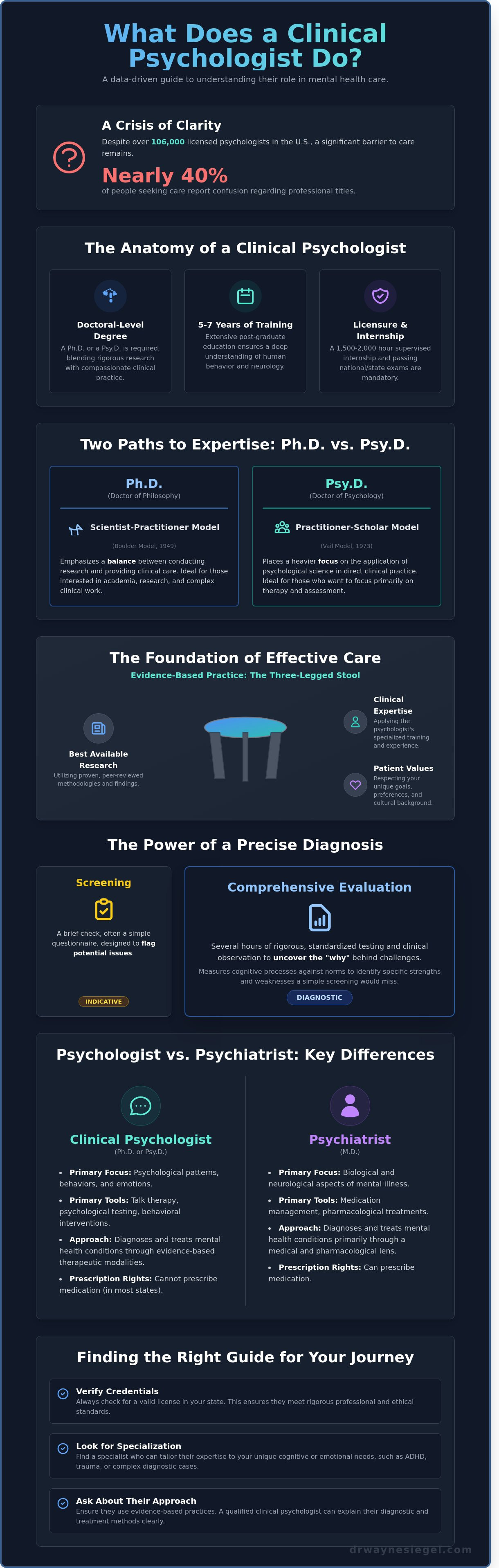
What if the most significant barrier to your mental health progress isn't a lack of effort, but a lack of clarity? According to the American Psychological Association, there are over 106,000 licensed psychologists in the United States, yet nearly 40 percent of people seeking care report confusion regarding professional titles. This leads many to ask: what does a clinical psychologist do? It's natural to feel anxious when you're navigating a complex diagnostic process or wondering if a professional can truly address specific concerns like ADHD or trauma. You deserve to know that your care is grounded in more than just opinion. You're looking for a steady, non-judgmental guide who uses science to map out a clear path forward.
I've written this guide to provide a research-backed understanding of how clinical psychologists use evidence-based care to diagnose and treat mental health conditions. We'll move past the confusion of professional titles to look at the actual mechanics of psychological testing and treatment. This article outlines the essential roles of a psychologist, the value of a precise cognitive profile, and how a data-driven approach builds the confidence you need to choose the right provider for your journey.
Key Takeaways
- Understand exactly what does a clinical psychologist do by exploring how they integrate doctoral-level research with compassionate, person-centered care.
- Discover how comprehensive diagnostic evaluations and standardized testing provide the clarity needed to uncover the "why" behind your specific challenges.
- Learn why evidence-based treatment protocols offer a more reliable roadmap for improvement than traditional, unstructured therapy approaches.
- Distinguish between the psychological focus of a clinical psychologist and the pharmacological approach of a psychiatrist to determine which path best supports your goals.
- Gain practical steps for verifying credentials and finding a licensed specialist who can tailor their expertise to your unique cognitive or emotional needs.
What is a Clinical Psychologist? Defining the Expert Role
When you're facing a complex emotional or cognitive challenge, you need a guide who understands the intricate science of the mind. A clinical psychologist is a doctoral-level professional who specializes in the science of mental health, blending rigorous research with compassionate clinical practice. If you find yourself asking what does a clinical psychologist do, the answer begins with the integration of theory and application. I view every assessment as a unique puzzle to be solved with care and precision, ensuring that the science we use translates into meaningful improvements in your daily life. Our primary goal is to reduce psychological distress and enhance your personal functioning, providing you with the clarity you need to move forward.
To reach this level of expertise, a clinical psychologist must complete five to seven years of doctoral training. This education culminates in either a PhD or a PsyD degree. A PhD, or Doctor of Philosophy, traditionally follows the Boulder Model established in 1949, which emphasizes a balance of research and practice. In contrast, a PsyD, or Doctor of Psychology, often follows the Vail Model from 1973, focusing more heavily on clinical application. Both paths require a 1,500 to 2,000-hour supervised internship and the successful completion of national and state examinations. This extensive background ensures that your care is grounded in a deep understanding of human behavior and neurological function.
The Clinical vs. Counseling Distinction
While many professionals offer therapy, the clinical designation carries a specific weight regarding diagnostic rigor. Clinical psychologists are uniquely trained to handle more complex psychopathology and severe mental health conditions that may affect the one in five adults living with a mental illness. We often work in medical settings, psychiatric hospitals, and specialized private practices where the focus is on the assessment of intricate disorders. Understanding what does a clinical psychologist do helps you see the value of a professional who treats the whole person while respecting the objective data. This distinction is vital when a case requires a high level of diagnostic precision to differentiate between overlapping cognitive and emotional symptoms.
The Foundation of Evidence-Based Practice
The field of Clinical psychology is built upon the scientist-practitioner model. This means that every recommendation I make is rooted in evidence-based practice. This approach is a three-legged stool consisting of the best available research, clinical expertise, and your unique patient values. We don't rely on intuition alone; we use standardized tools and objective data to inform the therapeutic process. By integrating these elements, we create a reliable roadmap for your journey toward wellness.
My commitment to this model ensures that your treatment isn't based on guesswork. Instead, we use proven methodologies to identify the "why" behind your challenges. This process transforms a clinical service into a personal partnership, where the ultimate objective is to provide you with the insight and tools necessary to improve your quality of life. We move beyond labels to find actionable meaning in every data point we collect.
The Power of Diagnostic Assessment and Psychological Testing
If you've ever wondered what does a clinical psychologist do, the answer starts with the science of assessment. I use standardized testing to see the invisible patterns of the mind. While a conversation provides essential context, objective data allows me to measure cognitive processes against established norms. This process aligns with the role of psychologists in health care as primary diagnostic experts who provide the data necessary for integrated treatment. We move beyond guesswork to identify exactly why certain tasks feel insurmountable while others come naturally.
The distinction between a screening and a comprehensive diagnostic evaluation is vital. A screening is a brief check, often a single page, designed to flag potential issues. In contrast, a comprehensive evaluation involves several hours of rigorous testing and clinical observation. I analyze your cognitive profile to identify strengths and weaknesses that a simple questionnaire would miss. By the end of this process, we aren't just looking at symptoms; we're looking at a complete map of your cognitive landscape. This level of detail ensures that the treatment plan we build is rooted in your specific reality rather than a general category.
I view these assessments as a roadmap for your future. Without a clear diagnosis, therapy can sometimes feel like wandering without a compass. Objective data provides the coordinates. We can pinpoint if a struggle with work performance is a result of an attention deficit, an anxiety disorder, or a specific memory impairment. This clarity allows us to target interventions with precision. If you feel stuck in a cycle of confusion, you can schedule a consultation to begin your own diagnostic journey and find the answers you deserve.
ADHD Assessments and Executive Functioning
Adult ADHD assessments in my practice involve far more than a simple checklist of distractibility. I measure specific components of executive functioning, including working memory, inhibition, and sustained focus. We look at how your brain manages complex information under pressure. A formal diagnosis is often the key to securing workplace or academic accommodations under the Americans with Disabilities Act of 1990, providing a level playing field for your unique cognitive style.
Neuropsychological and Personality Testing
These evaluations explore the intricate relationship between brain function and your daily behavior. By using personality assessments, I can uncover deep-seated emotional patterns that drive your reactions to stress or relationships. Understanding what does a clinical psychologist do in this context means recognizing the value of a professional who can synthesize complex data into a human story. Psychological testing provides the definitive clarity needed to transform years of silent struggle into an actionable, evidence-based plan for growth.
Treatment Modalities: The Science of Therapeutic Change
I often tell my patients that therapy is as much a science as it is a conversation. When people ask What is Clinical Psychology?, they're often looking for the specific mechanism of change. We've moved past the era of "eclectic" talk therapy, where a provider might simply try a bit of everything without a clear roadmap. Today, my work is rooted in structured, evidence-based protocols. These protocols are backed by peer-reviewed data that show precisely how specific interventions lead to measurable outcomes. Understanding what does a clinical psychologist do requires looking at these proven frameworks that guide every session toward a solution.
One of the most exciting aspects of this work is the concept of neuroplasticity. We now know that consistent therapeutic work can physically alter the brain's circuitry. For instance, targeted interventions can strengthen the prefrontal cortex's ability to regulate the amygdala, which is the brain's fear center. Research from 2017 suggests that 12 to 20 weeks of structured therapy can produce changes in brain activity comparable to pharmacological treatments. This is why I view our sessions as a collaborative partnership. We're working together to rewire the cognitive patterns that keep you stuck. I don't just provide instructions; I provide the tools for you to become your own therapist.
Cognitive Behavioral Therapy (CBT)
CBT is the gold standard for treating anxiety and depression. In individual psychotherapy sessions, we focus on the "triad": the relationship between thoughts, feelings, and behaviors. A 2012 meta-analysis of 269 studies confirmed its high efficacy for social anxiety. By identifying cognitive distortions like "catastrophizing," we create a pathway toward relief. It's a practical approach that gives you a clear roadmap for recovery.
Acceptance and Commitment Therapy (ACT)
ACT shifts the goal toward psychological flexibility. Instead of fighting difficult emotions, we learn to accept them while staying committed to your values. This is highly effective for chronic pain. A 2021 study showed that ACT helped 65% of participants improve daily functioning despite physical symptoms. By using mindfulness, I help you stop the "tug-of-war" with your symptoms so you can focus on your personal journey.
Modern psychological intervention is no longer a passive process where the patient listens and the doctor dictates. It's a high-level collaboration. I rely on your expertise in your own life just as much as you rely on my expertise in clinical science. To understand what does a clinical psychologist do in a modern setting, you must see the therapist as a guide who uses data from your daily life to refine the approach. We might track mood changes on a scale of 1 to 10 or identify specific triggers for panic. This data-driven approach ensures we aren't just talking; we're making progress you can actually see and feel. This structured path provides the clarity needed to move from a place of distress to a place of empowered action.
Clinical Psychologist vs. Psychiatrist: Understanding the Differences
Choosing the right mental health professional requires an understanding of how different experts approach the human mind. While the titles are often used interchangeably in casual conversation, the training and treatment methods of a psychiatrist and a clinical psychologist are distinct. A psychiatrist is a medical doctor who completes four years of medical school followed by a four-year residency in psychiatry. Their training is rooted in biology and pharmacology. They view mental health through a physiological lens, focusing on how chemical imbalances or physical issues in the brain affect your mood and behavior.
In contrast, my path as a clinical psychologist involved five to seven years of graduate study culminating in a PhD or PsyD. This education focuses heavily on human development, social behavior, and the complex science of psychological testing. When people ask what does a clinical psychologist do, the answer often lies in the pursuit of cognitive clarity. We don't look for a quick chemical fix; we look for the patterns in how you think, feel, and interact with your environment. Our goal is to provide a roadmap for long-term change through behavioral and psychological interventions.
The Prescribing Myth
There's a common misconception that all mental health doctors write prescriptions. In 45 states, clinical psychologists don't prescribe medication. This is not a limitation; it's a specialized strength. By focusing on "talk therapy" and neuropsychological testing, we dedicate our time to understanding the nuances of your personality and cognitive profile. A 2021 study published in Psychiatric Services found that many psychiatric visits for medication management last only 15 to 20 minutes. My approach is different. I spend significant time with you to identify the "why" behind your struggles. I also play a critical role in a multidisciplinary team by monitoring the psychological effects of any medications you may be taking. If a patient experiences a 15% decrease in cognitive processing speed after starting a new prescription, I provide the objective data your physician needs to adjust your care.
Working with Other Mental Health Professionals
The mental health field is a collaborative ecosystem. You might also encounter a Licensed Independent Clinical Social Worker (LICSW). These professionals typically hold a Master's degree and focus on providing therapy and connecting patients with social resources. While their work is vital, a clinical psychologist brings an additional layer of diagnostic expertise. We're trained to administer and interpret complex psychometric tests that other clinicians aren't licensed to use. This data provides the foundation for your entire treatment plan.
I often provide professional consultation to other therapists and medical doctors when a case is particularly complex or when a standard diagnosis isn't clear. This teamwork ensures that every angle of your well-being is considered. If you're struggling to find the right path forward, understanding what does a clinical psychologist do can help you see the value of a comprehensive evaluation. We provide the evidence-based insights that help your whole care team move in the right direction. My role is to be a steady guide, using rigorous science to help you regain a sense of order and purpose in your daily life.
If you're ready to move beyond symptoms and find a clear path to wellness, I'm here to help. Schedule a consultation today to begin your journey toward clarity.
How to Find a Qualified Clinical Psychologist
Choosing a provider is the first step toward the clarity you're seeking. It's a process that requires both a look at objective credentials and an assessment of personal fit. You should begin by verifying a professional's license through your specific state’s Board of Psychology database. This step confirms the practitioner has completed the necessary doctoral degree, which typically involves four to seven years of graduate study, and has passed the Examination for Professional Practice in Psychology (EPPP). In Minnesota, for instance, a licensed psychologist must also complete at least 2,000 hours of supervised professional experience before practicing independently.
Verification of these standards protects you. It ensures the person you're trusting with your cognitive and emotional health has met the rigorous requirements for safety and competence. When you ask yourself what does a clinical psychologist do, remember their primary role is to apply scientific research to your unique cognitive profile. This application is most effective when the provider has specialized experience. If you're seeking help for ADHD, executive functioning issues, or complex trauma, a generalist may not possess the depth of knowledge required to provide an accurate roadmap for your recovery.
The therapeutic alliance is another critical factor in your success. A 2018 meta-analysis by researchers Norcross and Lambert demonstrated that the quality of the relationship between the patient and the psychologist is a significant predictor of positive outcomes, regardless of the specific treatment type. This bond is built on trust, empathy, and a shared understanding of your goals. It's why I prioritize creating a safe, non-judgmental environment where you feel heard and understood from the very first meeting.
Before your initial consultation, prepare a list of questions to gauge the psychologist's approach and expertise. You might ask:
- How many years have you spent treating my specific concerns?
- What evidence-based modalities do you use in your practice?
- How do you measure progress throughout the diagnostic or treatment process?
- What does a clinical psychologist do in your specific practice to ensure my data remains confidential?
What Does Board Certification (ABPP) Mean?
Board certification through the American Board of Professional Psychology (ABPP) represents the highest level of clinical excellence in the field. Only about 4% of licensed psychologists in the United States hold this credential. To become board-certified, a psychologist must undergo a rigorous peer-review of their work samples and pass a live oral examination by senior experts. This voluntary process demonstrates a commitment to maintaining standards that go well beyond basic state licensing requirements.
Accessing Care: Minneapolis and PsyPact States
Telehealth has significantly expanded the ability to find specialized expertise regardless of your physical location. Through the Psychology Interjurisdictional Compact, I can provide services to patients located in over 40 PsyPact states as of 2024. This legal agreement allows for seamless care across state lines, ensuring you can maintain a connection with your provider even if you travel. I often find that while virtual sessions offer great flexibility, local expertise remains vital for those in Minneapolis. In-person evaluations are frequently preferred for complex neuropsychological testing where physical observation and a controlled, standardized environment are necessary for the most accurate diagnostic clarity.
By focusing on these professional markers and your own sense of comfort, you can find a partner who is both technically proficient and deeply invested in your well-being. This search is the foundation of your journey toward a better quality of life.
Your Roadmap to Lasting Mental Clarity
Understanding exactly what does a clinical psychologist do helps you move from a state of uncertainty to a structured plan for wellness. These specialists bridge the gap between complex psychological science and your daily quality of life. By utilizing rigorous diagnostic testing and evidence-based treatment modalities, they provide more than just a listening ear; they offer a precise roadmap for cognitive and emotional health. You deserve care that is grounded in peer-reviewed research and delivered with clinical precision.
Dr. Wayne Siegel, of Siegel Psychology Services, brings over 25 years of private practice experience. As a Board-Certified Clinical Psychologist (ABPP), he focuses on uncovering the "why" behind your unique challenges. His meticulous, evidence-based approach ensures thorough
Frequently Asked Questions
What is the difference between a clinical psychologist and a therapist?
Clinical psychologists hold a doctoral degree, such as a PhD or a PsyD, and undergo 4 to 7 years of specialized clinical training. While "therapist" is a broad term for various licensed professionals, I focus on the intersection of research and clinical practice. Clinical psychologists are uniquely trained to administer complex neuropsychological tests that standard counseling programs don't include. This high level of training ensures you receive care grounded in rigorous scientific standards.
Can a clinical psychologist diagnose mental health conditions?
Yes, a clinical psychologist is legally and professionally qualified to diagnose mental health and neurodevelopmental conditions. When people ask what does a clinical psychologist do, a primary function is using standardized tools like the MMPI-3 to identify specific disorders. In my practice, I provide a formal diagnostic report that serves as a medical record for schools or employers. This clarity helps us build an accurate roadmap for your treatment journey.
What happens during a psychological evaluation?
A psychological evaluation involves a structured clinical interview followed by standardized testing to measure cognitive and emotional functioning. I typically spend 2 to 4 hours with you gathering data on your history and current symptoms. We use evidence-based instruments to assess areas like executive functioning and memory. This process transforms subjective struggles into objective data; it gives us a clear picture of your unique cognitive profile and strengths.
How long does it take to see a clinical psychologist for an assessment?
The entire assessment process usually takes 2 to 3 weeks from the initial interview to the final feedback session. I spend approximately 5 to 10 hours analyzing your test results and writing a comprehensive report. This timeline ensures I have the necessary space to be meticulous with your data. You'll receive a detailed document that outlines specific recommendations for your daily life and future care in a timely manner.
Do clinical psychologists only work with 'crazy' people?
No, clinical psychologists work with individuals across the entire spectrum of human experience, including those seeking to optimize high-level performance. Statistics from the National Institute of Mental Health show that 1 in 5 U.S. adults live with a mental health condition. Many of my clients are professionals or students looking to improve their executive functioning or manage stress. We focus on your strengths to help you navigate life's complexities more effectively.
What is the success rate of evidence-based therapies like CBT?
Cognitive Behavioral Therapy (CBT) shows a 50% to 75% effectiveness rate for treating anxiety and depression after 8 to 15 sessions. Research published in the Journal of the American Medical Association confirms that CBT is often as effective as medication for many conditions. I rely on these evidence-based protocols because they offer predictable, measurable results. This scientific approach helps you develop practical skills to change thought patterns and improve your daily quality of life.
How do I know if I need a psychologist or a psychiatrist?
You should see a psychiatrist if you need medication management, but you see a psychologist for diagnostic clarity and talk therapy. To understand what does a clinical psychologist do versus a psychiatrist, remember that I focus on behavioral interventions and psychological testing. Psychiatrists are medical doctors who primarily prescribe drugs like SSRIs. I often collaborate with psychiatrists to provide a dual approach that addresses both your biological and behavioral needs.
Does insurance cover clinical psychology services?
Most major insurance plans cover clinical psychology services, though coverage for specific neuropsychological testing varies by provider. I recommend calling your insurer to ask about CPT codes 96132 and 96133 for evaluation services. Approximately 80% of private plans provide some level of reimbursement for diagnostic assessments. My office provides the necessary documentation to help you navigate the claims process; we want to help you maximize your available benefits.