
The Benefits of Private Pay Psychotherapy: Clinical Excellence Without Administrative Limits

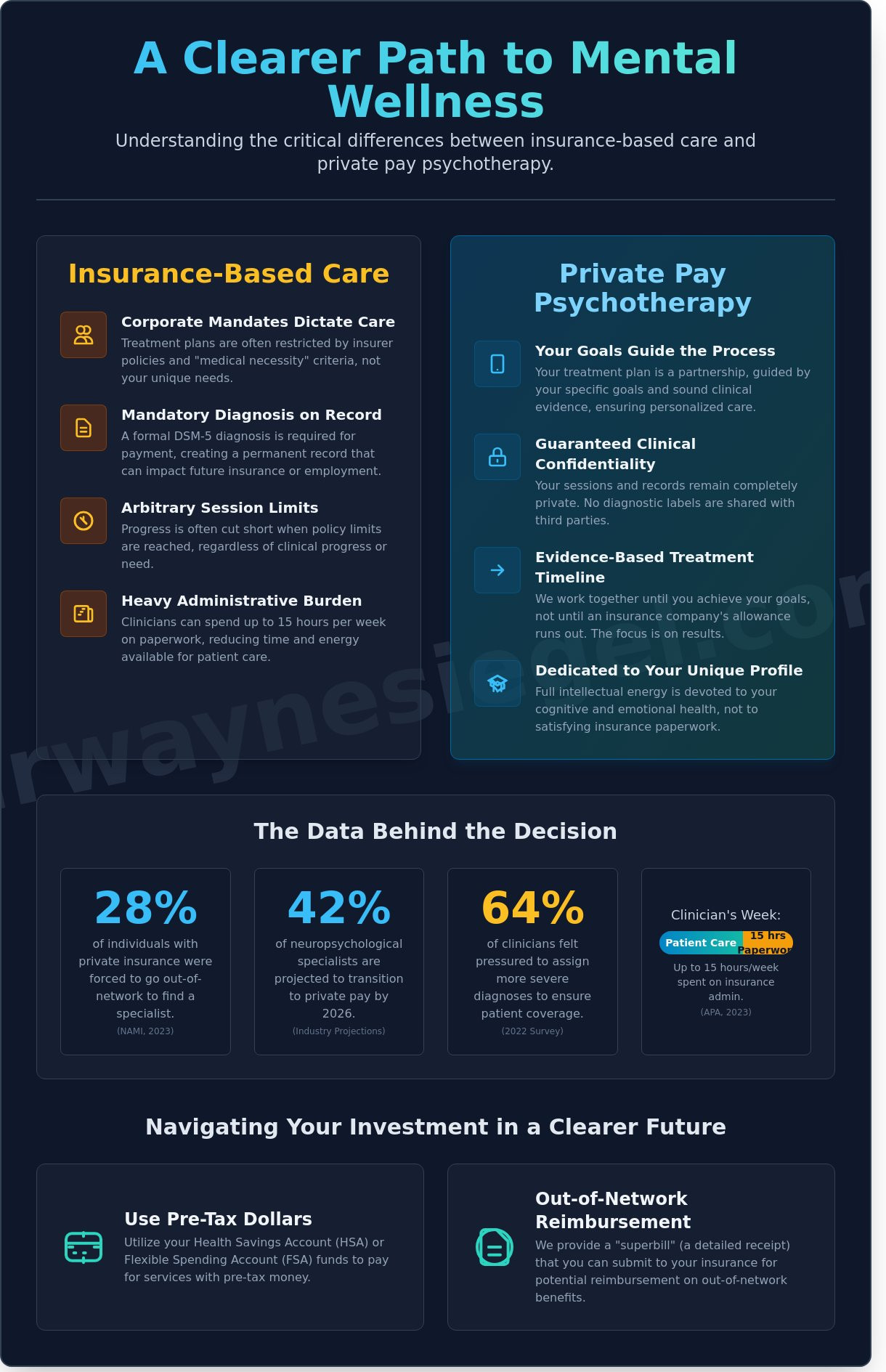
What if the insurance card in your wallet is actually the primary barrier to receiving the specialized, confidential care you require? You likely value the security of your health coverage, yet you've probably felt the frustration of being limited to a specific number of sessions or struggling to find a board-certified specialist who truly understands your unique cognitive profile. A 2023 report by the National Alliance on Mental Illness found that 28% of individuals with private insurance were forced to go out-of-network to access mental health specialists, highlighting a significant gap in accessible, high-quality care.
At Siegel Psychology Services, we understand that your mental health journey is deeply personal, and the benefits of private pay psychotherapy offer a way to bypass these systemic limitations. By choosing this path with us, we ensure that your treatment plan is guided by clinical evidence and your specific goals rather than a corporate mandate. You deserve a process that prioritizes your privacy and provides a clear roadmap to clarity without the requirement of a permanent diagnostic label. This article examines how opting for private pay allows us to build a partnership focused entirely on your long-term well-being and clinical excellence.
Key Takeaways
- Understand why board-certified specialists are transitioning to a private pay model to bypass the increasing administrative restrictions of insurance panels.
- Learn how bypassing third-party mediation protects your clinical confidentiality and prevents diagnostic labels from impacting your future life or disability insurance premiums.
- Discover the benefits of private pay psychotherapy in ensuring your treatment timeline is dictated by evidence-based practices rather than arbitrary "medical necessity" criteria.
- Gain insight into why the most experienced practitioners prioritize independent practice to maintain the rigorous standards required for complex diagnostic clarity.
- Explore practical ways to manage your investment through out-of-network "superbill" reimbursements and the strategic use of HSA or FSA funds.
Understanding the Private Pay Model in Modern Mental Health
Private pay, often referred to as self-pay, describes a professional arrangement where you pay for psychological services directly. In this model, we remove third-party insurance companies from the clinical decision-making process. By the start of 2026, industry projections indicate that nearly 42% of board-certified neuropsychological specialists will transition to a self-pay model. This shift isn't merely about economics; it's about reclaiming the quality and depth of care. When I work with you outside the constraints of an insurance panel, our focus remains entirely on your cognitive and emotional health rather than meeting the arbitrary criteria of a distant corporation.
The difference between managed care and person-centered care is fundamental to your progress. Managed care prioritizes cost containment, often treating mental health as a series of symptoms to be suppressed. In contrast, person-centered care treats you as a unique individual with a complex history. To begin Understanding Psychotherapy as a tool for genuine growth, we must recognize that a thorough diagnostic process takes time. One of the key benefits of private pay psychotherapy is that it grants us the space to explore the root causes of your challenges without a pre-determined expiration date on your treatment plan.
Managed Care vs. Private Practice
In a managed care setting, insurance companies act as silent partners in the therapy room. They often require detailed justifications for every session, which fundamentally compromises your privacy and the sanctity of the clinical space. A 2023 report by the American Psychological Association highlighted that clinicians in high-volume, insurance-based clinics spend up to 15 hours per week on administrative paperwork. This administrative burden often leads to clinician burnout and a "revolving door" approach to treatment. My practice chooses to prioritize individualized, evidence-based practice over the volume-heavy model of associated clinics. This ensures I can dedicate my full intellectual energy to your specific cognitive profile rather than checking boxes for a middleman.
The Concept of Clinical Purity
One of the primary benefits of private pay psychotherapy involves the preservation of clinical purity. This is the ability to provide the exact treatment you need without external interference. In an insurance-based model, I'm often forced to "code" sessions into specific diagnostic categories simply to ensure payment. This practice can limit us to basic symptom management. By choosing the private pay model, we move beyond labels to find the "why" behind your executive functioning or emotional struggles. We gain the freedom to utilize the full spectrum of Cognitive Behavioral Therapy (CBT) and Acceptance and Commitment Therapy (ACT) without being time-capped. We don't stop because a policy limit was reached; we stop when you've achieved the clarity and the actionable roadmap you deserve for your daily life.
Protecting Your Confidentiality: The Clinical Impact of Bypassing Insurance
Many patients I work with express concern about their "permanent record." This isn't just a myth. When you use insurance for mental health services, the company requires a formal DSM-5 diagnosis to justify payment. This label becomes a permanent part of your medical history. It's often shared across interconnected databases used by various healthcare providers and insurers. One of the primary benefits of private pay psychotherapy is the ability to keep your clinical journey truly private, ensuring that your personal growth stays between us.
The Mandatory Diagnosis Requirement
Insurance companies operate on a strict medical model. They only pay for "disorders" that they deem medically necessary. This means if you're struggling with a difficult divorce, a career transition, or general self-improvement, I'd have to assign you a pathological label for them to cover the cost. A 2022 survey of mental health professionals found that 64% of clinicians felt pressured to assign more severe diagnoses than necessary to ensure patient coverage. Private pay removes this pressure. You can seek clarity and support without a lifelong label attached to your name.
Beyond the office, these labels carry weight. When you apply for life insurance or long-term disability coverage, underwriters often request access to your medical records. Data from the American Council of Life Insurers indicates that a history of certain mental health diagnoses can lead to premium increases of 20% to 50% or even a denial of coverage. By paying out of pocket, you ensure that your personal evolution doesn't become a financial liability in the future.
Data Privacy in the Digital Age
Electronic Health Records (EHR) are standard, but their reach varies. When insurance is involved, your data travels through clearinghouses and into large corporate databases. These systems are vulnerable to breaches. In my practice, I maintain strict internal control over your sensitive psychological data. I don't share your progress notes, treatment plans, or session details with third-party databases.
Protected Health Information (PHI) in the context of private pay security is the collection of your personal health details that stays within my encrypted, local system, never reaching a third-party auditor's desk.
There's a profound sense of psychological safety in knowing no one is looking over our shoulders. Insurance companies often conduct "utilization reviews" where they demand to see my session notes to verify you're making "enough" progress according to their metrics. This can feel like an intrusion into a sacred space. In a private pay model, our work stays between us. We focus on your timeline, not a corporate spreadsheet. This creates a roadmap for gaining clarity on your unique cognitive profile without external interference.
- Internal Control: Your records are not accessible to insurance adjusters or corporate auditors.
- No Forced Labels: We focus on your goals, not fitting into a DSM-5 category for billing.
- Future Protection: You protect your eligibility for future life and disability insurance policies.
While exploring the benefits of private pay psychotherapy, many clients find that the financial investment is outweighed by the peace of mind. You deserve a space where you can be completely honest without worrying about how your words might be used by a third party years from now. This clinical independence allows us to build a relationship based on trust and genuine clinical need rather than administrative requirements.
Clinical Autonomy vs. 'Medical Necessity': Why Evidence-Based Care Needs Flexibility
Insurance companies define medical necessity through a narrow lens of acute symptom reduction. They require a formal diagnosis and evidence of significant functional impairment to authorize payment for sessions. This framework often creates a direct conflict with evidence-based practices like Cognitive Behavioral Therapy (CBT) or Acceptance and Commitment Therapy (ACT). While research from the American Psychological Association confirms these methods are highly effective, their success depends on a timeline tailored to the individual rather than a corporate spreadsheet. One of the primary benefits of private pay psychotherapy is the removal of these arbitrary barriers. It allows us to focus on your actual progress rather than meeting a third-party's definition of being "sick enough" to deserve care.
The 'Sick Enough' Trap
Managed care models often penalize progress by withdrawing support as soon as symptoms show moderate improvement. This approach ignores the 40% to 60% relapse rates observed in clinical depression when treatment ends before a solid maintenance phase is established. I prioritize the use of ACT to build long-term resilience, which requires staying in therapy beyond the initial crisis. We work together to ensure you've developed the psychological flexibility needed to handle future stressors. Private pay ensures that we don't have to stop just because you've reached a baseline of "stability" defined by an outside reviewer who hasn't met you.
Customizing the Therapeutic Roadmap
Standard 45-minute insurance sessions don't always provide the necessary space for complex trauma processing or detailed diagnostic work. In my practice, I have the autonomy to schedule 90-minute blocks for intensive processing or increase session frequency to twice-weekly during critical life transitions. Understanding the benefits of private pay psychotherapy involves recognizing this level of customization. We also integrate results from neuropsychological evaluations into your treatment plan immediately. We don't wait for a 14-day or 30-day insurance authorization period to adjust our approach based on new data regarding your executive functioning or cognitive profile.
Comprehensive evaluations for ADHD and other complex diagnostic puzzles require an exhaustive review of your history and cognitive data. A 2022 report in the Journal of Clinical Psychiatry indicated that clinicians spend an average of 6 to 8 hours on a thorough diagnostic battery for complex cases. Insurance providers frequently cap these assessments at much lower levels, which can lead to incomplete or rushed conclusions. By choosing a private pay model, we guarantee the "deep dive" required for true clarity. I view every assessment as a unique puzzle. We take the time to solve it with precision, ensuring the roadmap we create is based on a complete picture of your strengths and challenges.
- Clinical Freedom: Decisions are made by the doctor and patient, not an insurance adjuster.
- Extended Sessions: The ability to use 90-minute sessions for EMDR or complex trauma work.
- Continuity of Care: Treatment continues through the maintenance phase to prevent relapse.
- Immediate Integration: Testing results inform treatment without waiting for external approval.
A 2021 study published in The Lancet highlighted that personalized, flexible treatment durations lead to a 15% increase in long-term positive outcomes compared to rigid, time-limited models. This flexibility is a cornerstone of my practice. It allows me to act as your steady guide, moving at a pace that respects your unique cognitive and emotional landscape while maintaining the highest clinical standards. We focus on the "why" behind your challenges to improve your daily quality of life, ensuring you have a clear path forward that isn't dictated by an insurance policy.
The Value of Board-Certified Expertise and Specialized Care
Choosing a psychologist is a significant investment in your long-term cognitive health. One of the primary benefits of private pay psychotherapy is the direct access it provides to highly specialized practitioners who've intentionally moved away from the constraints of insurance networks. Dr. Siegel operates an independent practice to ensure that clinical decisions are based on rigorous evidence and individual patient needs rather than bureaucratic quotas. This model allows for a deep, focused exploration of complex conditions like ADHD and trauma where a generalist approach often fails to provide the necessary depth. When a provider isn't restricted by the 45-minute sessions often mandated by insurance contracts, they can dedicate the time required for a truly comprehensive evaluation.
The correlation between specialized expertise and independent practice is clear. Professionals who have spent decades refining their skills in specific areas, such as executive functioning or neuropsychological assessments, often find that the private pay model is the only way to maintain their standard of care. This independence fosters a person-centered partnership. You aren't just a claim number in a database; you're a collaborator in a diagnostic journey designed to uncover your unique cognitive profile and strengths.
The Significance of Board Certification (ABPP)
In 2026, board certification through the American Board of Professional Psychology (ABPP) remains the gold standard of clinical excellence. This distinction signifies that a psychologist has successfully completed a rigorous peer-review process that evaluates their actual clinical work against the highest national standards. Only approximately 4 percent of licensed psychologists in the United States hold this certification. Seeking a specialist with these credentials is a more efficient path to clarity than visiting generalist clinics. These specialists use evidence-based protocols to provide a roadmap for your care, ensuring that every recommendation is grounded in verifiable data rather than guesswork.
PsyPact and National Access
Modern clinical care shouldn't be limited by geographic boundaries. PsyPact is an interstate compact that currently allows Dr. Siegel to provide services to clients in 42 states. This ensures continuity of care for individuals who travel for work or relocate within participating states. One of the logistical benefits of private pay psychotherapy is the ability to maintain a consistent therapeutic relationship without worrying about whether a new state's insurance network covers your specific provider. PsyPact expands the online therapy landscape by providing a legal framework for Dr. Siegel to deliver specialized neuropsychological assessments to clients across state lines.
The shift from a provider-patient transaction to a personal partnership is fundamental to the way Dr. Siegel practices. He views every assessment as a unique puzzle to be solved with precision and empathy. This approach transforms the clinical environment into a safe space for discovery. You can schedule a consultation with Dr. Siegel to begin the process of gaining clarity through expert, board-certified care.
Navigating Your Investment: How We Partner for Your Long-Term Clarity
Choosing private pay is a deliberate decision to prioritize the quality, depth, and confidentiality of your care. It's helpful to view this choice through the lens of a long-term Return on Investment (ROI). Research from the Journal of Clinical Psychology indicates that targeted, evidence-based assessments lead to more accurate clinical pathways, which can shorten the total duration of treatment by 15% or more. This efficiency prevents the "revolving door" of ineffective therapy that often results from generalized care. One of the primary benefits of private pay psychotherapy is the ability to bypass insurance-mandated timelines, allowing us to focus entirely on your specific cognitive and emotional needs.
A 2021 study by the National Council for Mental Wellbeing found that early, specialized intervention can reduce long-term healthcare costs by up to 20% by addressing root causes rather than just managing symptoms. When you invest in a comprehensive evaluation, you're not just paying for a series of appointments; you're securing a roadmap that saves years of trial-and-error treatment. This approach ensures that every session is a step toward measurable progress.
Maximizing Your Insurance Benefits Indirectly
You can still leverage your insurance coverage even within a private pay model. Most "PPO" or "Point of Service" plans include out-of-network (OON) benefits that reimburse a significant portion of the cost. Approximately 75% of my clients who utilize out-of-network benefits receive reimbursement for 50% to 80% of the allowable amount after meeting their deductible. To clarify your specific coverage, I recommend calling the number on the back of your insurance card and asking these three precise questions:
- "What is my out-of-network deductible for outpatient mental health services?"
- "What is my reimbursement rate for CPT code 90791 (Psychiatric Diagnostic Evaluation)?"
- "Do I have a maximum out-of-pocket limit for the year?"
I provide a "Superbill" at the end of each month to facilitate this process. This document is a detailed clinical receipt containing all necessary diagnostic codes and provider information. You simply upload this to your insurance portal, and they typically issue a reimbursement check directly to you within 30 days. Furthermore, using a Health Savings Account (HSA) or Flexible Spending Account (FSA) allows you to pay with pre-tax dollars. Depending on your tax bracket, this effectively reduces the cost of care by 22% to 37%.
Some clients choose not to submit documentation to insurance at all. This is another of the key benefits of private pay psychotherapy, as it ensures your mental health records remain entirely outside the insurance database. This prevents a permanent "medical necessity" label from affecting future life or disability insurance premiums, providing an extra layer of professional and personal security.
The Path to Clarity and Strengths
Our work is designed to move beyond simple labels. We focus on actionable insights that improve your daily quality of life. By identifying your unique executive functioning profile, we can develop strategies that work with your brain's natural architecture rather than against it. This process transforms a clinical assessment into a personal partnership, providing you with a steady, non-judgmental guide through your cognitive landscape.
My goal is to empower you through understanding. When you have a clear picture of your strengths and challenges, the path forward becomes visible and manageable. If you're ready to move toward a deeper understanding of your cognitive profile, Contact Dr. Wayne Siegel to discuss your individualized path to clarity. We'll work together to build a roadmap that honors your privacy while maximizing your potential for growth.
Securing Your Path to Lasting Clarity
Choosing a private pay model ensures your mental health records remain strictly confidential. I don't share your private data with insurance companies, which protects your professional and personal future from unnecessary disclosure. This autonomy allows us to prioritize evidence-based protocols like Cognitive Behavioral Therapy (CBT) and Acceptance and Commitment Therapy (ACT) based on your specific needs rather than restrictive mandates. I've been a Board-Certified Clinical Psychologist (ABPP) since 1996, and I'm dedicated to providing specialized care that focuses on your unique roadmap to insight. One of the primary benefits of private pay psychotherapy is the freedom it gives us to pursue clinical excellence without administrative interference. Whether you're in Minnesota or one of the 40+ states where I'm PsyPact authorized for telehealth, you deserve a partnership grounded in integrity and rigorous science. I'm here to help you navigate this complex landscape with the precision and care you require. We'll find the answers together.
Schedule a Consultation with Dr. Siegel to Gain the Clarity You Deserve
Frequently Asked Questions
Is private pay psychotherapy worth the additional cost?
Yes, private pay psychotherapy is worth the investment because it guarantees absolute confidentiality and clinical freedom. When you pay out-of-pocket, I'm not required to share your session notes or progress with a third-party payer. This level of privacy is a primary benefits of private pay psychotherapy. You also gain the freedom to determine the length and frequency of your care without 15-minute or 45-minute session limits imposed by corporate insurance policies.
Can I use my HSA or FSA card to pay for therapy sessions?
You can typically use your Health Savings Account (HSA) or Flexible Spending Account (FSA) to pay for my services. These accounts use pre-tax dollars, which effectively reduces your out-of-pocket costs by 20% to 30% depending on your specific tax bracket. I accept these cards directly through my secure payment system. It's a practical way to manage your healthcare budget while receiving high-quality, evidence-based care tailored to your specific cognitive or emotional needs.
What is a 'Superbill' and how does it work for out-of-network reimbursement?
A superbill is a specialized invoice that includes all the clinical information insurance companies require for out-of-network reimbursement. This document contains my tax ID, NPI number, and the specific ICD-10 diagnosis code for your condition. You submit this form to your insurance provider through their online portal. Depending on your specific plan, you might receive 50% to 80% of the session fee back once you meet your annual deductible requirement.
Why do insurance companies require a mental health diagnosis?
Insurance companies require a formal diagnosis because they only pay for services they deem "medically necessary" under the Mental Health Parity and Addiction Equity Act of 2008. This means I must assign you a clinical label from the DSM-5 to justify your treatment to them. For many patients, this label becomes a permanent part of their medical record. Private pay allows us to focus on your personal growth and clarity without the requirement of a pathologizing diagnosis.
Will my insurance company find out I am in therapy if I pay privately?
Your insurance company won't know you're in therapy if you pay privately and choose not to submit superbills for reimbursement. This creates a complete firewall between your private sessions and your permanent medical history. Data from the 2023 Milliman Report suggests that insurance-linked records are accessible by various entities during life insurance or disability underwriting. By opting for the benefits of private pay psychotherapy, you maintain 100% control over who sees your sensitive information.
Does Dr. Siegel offer psychological testing and ADHD assessments through private pay?
I offer comprehensive psychological testing and adult ADHD assessments exclusively through private pay to ensure the highest level of detail and clinical integrity. A typical adult evaluation involves 4 to 6 hours of direct testing and clinical interviewing. This thorough approach provides you with a clear roadmap for managing executive functioning challenges. By working outside the insurance model, I can spend the necessary time to provide a precise cognitive profile rather than rushing through a 60-minute screening.
How does PsyPact affect my ability to see a psychologist in another state?
PsyPact is an interstate compact that allows me to provide telehealth services to patients in 40 participating states. This means if you live in a PsyPact state like Minnesota or Texas, we can work together even if I'm not physically in your city. It ensures you have access to specialized neuropsychological expertise regardless of your geography. This agreement was established to increase consumer access to care while maintaining rigorous professional standards across state lines.
What happens if I start with private pay and then want to switch to insurance later?
You can switch to using insurance later if I'm a paneled provider for your plan, but you should know this ends your total privacy. Once we bill insurance, I'm required to provide them with your diagnosis and treatment dates. If you've spent 6 months in private pay, those previous records remain private; however, all subsequent sessions will be visible to your insurer. We'll discuss this transition carefully to ensure you understand how it affects your clinical roadmap and long-term privacy goals.