
What to Do When Therapy Feels Hard: A Clinical Perspective on Progress

What if the sessions that leave you feeling the most drained are actually the ones producing the most cognitive growth? It's common to feel frustrated when progress isn't a straight line, especially when you're unsure what to do when therapy feels hard. You might feel a temporary increase in anxiety as you confront old patterns; however, clinical data suggests that roughly 20% of patients experience a "deterioration effect" or a spike in symptoms before achieving a significant breakthrough. I want to validate that this struggle isn't a sign of failure, but often a necessary part of the brain's process of reorganizing and healing.
In this article, I'll provide an evidence-based framework to help you distinguish between productive discomfort and a genuine mismatch with your provider. We'll examine the neurobiology of change and outline three specific steps you can take to discuss these challenges during your next session. My goal is to help you gain the clarity you need to move past frustration and turn these hurdles into a roadmap for your long-term well-being.
Key Takeaways
- Understand why the "U-shaped curve" of progress often causes symptoms to temporarily intensify before significant clinical improvement occurs.
- Explore how evidence-based frameworks like CBT and ACT provide the structure needed to navigate deep-seated cognitive resistance and emotional labor.
- Learn to distinguish between the productive struggle of growth and a poor therapeutic fit through a clinical audit of your progress.
- Discover actionable strategies for what to do when therapy feels hard, including the importance of radical transparency with your provider.
- Gain clarity on how a strategic, board-certified approach ensures that every therapeutic challenge is aligned with your roadmap for long-term well-being.
Why Therapy Feels Difficult: The Clinical Reality of Emotional Labor
If you've ever left a session feeling more exhausted than when you arrived, you aren't alone. I often tell my patients that the process of healing isn't a linear path; it's a demanding cognitive task that requires immense energy. Understanding the clinical reality of emotional labor helps us see why this happens. Therapeutic discomfort is the specific strain that occurs when we challenge long-standing neural pathways. It's the brain's reaction to the effort of processing deep-seated patterns that have been in place for years, sometimes decades. When we look at what to do when therapy feels hard, we must first validate that this fatigue is a physiological response to intense mental work.
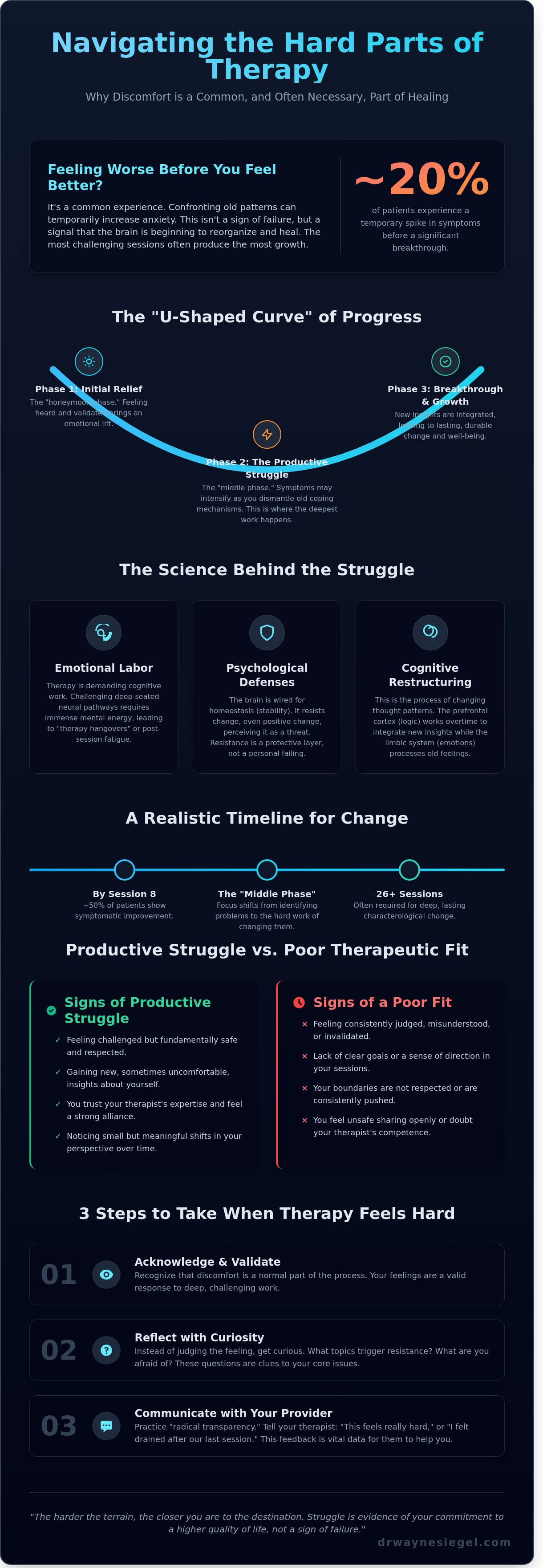
Clinical data supports this experience through the "dose-response" model. Research by Howard et al. (1986) demonstrated that while approximately 50% of patients show symptomatic improvement by session 8, the deeper work of characterological change often requires 26 sessions or more. During this extended period, many people experience a "U-shaped curve" of progress. This means your symptoms might temporarily intensify as you begin to dismantle old coping mechanisms. It’s a bit like cleaning a cluttered room; things often look much worse in the middle of the process than they did at the start. This destabilization is frequently a sign that you're moving toward the core of the issue rather than just grazing the surface.
Your brain is naturally wired to seek homeostasis, or a state of stable equilibrium. When we introduce change, even healthy change, the brain perceives it as a threat. This triggers psychological defenses. These are internal filters that try to protect us from emotional pain by avoiding certain topics or rationalizing behaviors. I view these defenses not as obstacles to be smashed, but as protective layers that we must gently acknowledge. When you feel a sudden urge to cancel a session or find yourself "blanking" on a topic, it's often your brain's security system trying to keep you safe from perceived emotional threats.
The 'Middle Phase' Phenomenon
The initial stage of therapy often brings a sense of relief. Being heard and validated provides a significant emotional lift. However, once the "honeymoon phase" ends, the work shifts from surface-level venting to deep-seated cognitive restructuring. This transition marks the beginning of the middle phase, where we move from identifying problems to the difficult task of changing them. It's common to experience "therapy hangovers," which is a state of post-session fatigue or irritability. This occurs because the prefrontal cortex is working overtime to integrate new insights while the limbic system processes old emotions. Approximately 20% of patients report feeling "worse" during this phase, yet this is often where the most durable growth occurs.
Deconstructing the Fear of Failure
A common misconception is that feeling bad in therapy means the treatment is failing. In my practice, I find the opposite is often true. If you're wondering what to do when therapy feels hard, remember that difficulty is a metric of depth. The brain resists change because the old, unhealthy patterns are familiar and "safe." When you reach a point of high resistance, you've likely reached a core issue. Think of this as a roadmap: the harder the terrain, the closer you are to the destination. We aren't looking for a quick fix; we're building a clearer picture of your life to find actionable meaning. This struggle is evidence of your commitment to a higher quality of life, not a sign of failure.
The Science of Resistance: How ACT and CBT Approach Difficulty
Resistance in therapy is rarely a sign of personal failure. Instead, it is a biological and psychological signal that you've reached the boundary of your comfort zone. Understanding what to do when therapy feels hard begins with recognizing that discomfort is often the primary mechanism of change. Clinical frameworks like Cognitive Behavioral Therapy (CBT) and Acceptance and Commitment Therapy (ACT) don't just acknowledge this difficulty; they use it as a tool to build psychological flexibility. This process requires significant metabolic energy from the prefrontal cortex, the area of the brain responsible for executive functioning and emotional regulation.
CBT and the Discomfort of Cognitive Restructuring
Cognitive Behavioral Therapy, pioneered by Dr. Aaron Beck in the 1960s, operates on the principle that our thoughts, feelings, and behaviors are inextricably linked. The "hard work" here often stems from cognitive restructuring. I define cognitive restructuring as a data-driven process of auditing one's own thoughts to identify and correct logical errors known as cognitive distortions. When we challenge a belief we've held for 25 years, the brain often reacts as if it's losing its sense of reality. This creates a state of cognitive dissonance that feels physically and emotionally draining. Exposure therapy, a core component of CBT, requires patients to face specific fears directly. While this is clinically necessary to break the cycle of anxiety, it is inherently taxing because it forces the nervous system to remain present during a perceived threat until habituation occurs.
ACT and the Practice of Expansion
Acceptance and Commitment Therapy, developed by Steven C. Hayes in 1982, takes a different but equally challenging path. ACT focuses on "experiential avoidance," which is the human tendency to run from internal pain. We often spend 100% of our energy trying to suppress anxiety or sadness, which only serves to amplify the suffering. ACT introduces the concept of creative hopelessness. This isn't a state of despair; it's the realization that the old tools you've used to "fix" your feelings aren't working. Giving up the struggle against your own emotions feels counterintuitive and frightening. However, by leaning into this discomfort, you practice "expansion," which reduces the power of the emotion over time. Values serve as the essential anchor during this process. When the journey feels unbearable, we look at your core values to provide the necessary motivation to continue. Gaining this level of clarity through a professional evaluation can help you identify which therapeutic approach fits your unique cognitive profile.
The transition from avoidance to engagement is a sophisticated cognitive shift. It relies heavily on your executive functioning to manage the "heavy lifting" of staying present when every instinct tells you to retreat. Research indicates that patients who successfully navigate these periods of high difficulty often show the most significant long-term improvements in daily quality of life. Knowing what to do when therapy feels hard involves recognizing that these moments of resistance are actually the points where your brain is most primed for growth. It's a sign that the "audit" of your internal world is working, moving you toward a clearer and more stable version of yourself.
Productive Struggle vs. Poor Fit: Evaluating Your Progress
I often explain to my patients that therapy is much like physical rehabilitation. It requires significant effort and can be uncomfortable. However, it's vital to distinguish between the "good" pain of emotional growth and the "bad" pain of a failing therapeutic relationship. Research by Lambert and Barley (2001) shows that the therapeutic alliance accounts for 30% of the variance in patient outcomes. This connection is the engine of change. If the engine isn't working, the car won't move, no matter how hard you push. I want you to feel that your therapist is a steady partner in this process, not an obstacle to it.
To audit your relationship, look for a balance of clinical authority and warm empathy. I strive to provide a steady, non-judgmental guide through your cognitive landscape. A 2011 meta-analysis in the journal Psychotherapy found that therapist empathy is a robust predictor of successful outcomes, contributing roughly 9% to the overall success rate. You need a provider who is technically proficient in neuropsychological principles but also deeply invested in your personal well-being. If the clinical science is present but the compassion is missing, the process will feel cold and mechanical. Conversely, empathy without clinical structure can leave you feeling supported but stagnant.
Sometimes, you might experience a "therapeutic rupture." This is a moment of tension, disagreement, or misunderstanding between you and your therapist. While these moments are stressful, they are actually critical opportunities for growth. Research by Safran and Muran in 2000 demonstrated that repairing these ruptures often leads to stronger bonds and better results than if the tension never existed. It's a safe way to practice resolving conflict in a controlled environment. When you bring these feelings to your therapist, their response tells you everything you need to know about the fit. A defensive response is a red flag; a curious, open response is a sign of a strong alliance.
Signs of a Productive Struggle
In a healthy therapeutic process, you feel challenged but consistently safe and respected. The difficulty you experience should relate to the heavy topics we discuss, such as trauma or executive functioning deficits, rather than the therapist’s behavior. You'll often find that even after a painful session, you gain a sense of "insight" and "clarity." This indicates the work is moving you toward your goals. When you're wondering what to do when therapy feels hard, check if you still trust your provider’s intent and expertise despite the discomfort.
When the Difficulty is an Unproductive Fit
If you don't see a clear, evidence-based roadmap, the fit might be the problem. A 2019 study in The Lancet showed that structured treatment plans increase patient retention by 15%. You shouldn't feel unheard, judged, or fundamentally misunderstood. If a therapist lacks specific expertise in your unique needs, such as a specific cognitive profile or ADHD, the process stalls. Knowing what to do when therapy feels hard involves recognizing when the clinician's skill set doesn't match your requirements. If you feel like you're constantly educating your therapist on your condition, it's time to re-evaluate the partnership.
Actionable Strategies to Navigate the Hard Parts of Therapy
When you reach a point where the emotional weight of your sessions feels overwhelming, it is often a sign that you are touching on the core issues that require the most attention. Understanding what to do when therapy feels hard allows you to transform a moment of resistance into a breakthrough. I often tell my patients that therapy is not a linear path; it's a process of titration where we must balance the intensity of the work with your current capacity to process it. A 2021 study published in the journal Psychotherapy indicates that approximately 20% of patients experience a temporary increase in distress before significant clinical improvement occurs. This "U-shaped" recovery curve is a documented phenomenon in evidence-based practice.
I encourage radical transparency in our sessions. If the work feels too heavy, telling your therapist is the most productive step you can take. It provides us with vital clinical data about your internal boundaries and your current window of tolerance. We use this information to adjust the pacing of the treatment. Sometimes, this means moving from weekly sessions to bi-weekly meetings to allow more time for integration; other times, it involves shifting the focus from deep trauma processing to immediate stabilization and coping skills.
How to Talk to Your Therapist About the Struggle
Opening a dialogue about your discomfort is a courageous act that strengthens the therapeutic alliance. You might start by saying, "I'm feeling stuck and I've been afraid to come to my sessions lately." Or, "The topics we discussed last week felt too intense, and I’m struggling to recover." I welcome this feedback because it allows me to recalibrate our roadmap. We can adjust the "dosage" of the intervention, ensuring the work remains challenging enough to be effective but safe enough to be sustainable. Research from 2018 suggests that addressing these alliance ruptures directly is one of the strongest predictors of positive treatment outcomes.
Post-Session Integration and Self-Care
The work doesn't end when you leave my office. I recommend a 20-minute "buffer rule" to help you transition from the clinical space back to your daily responsibilities. Instead of rushing to a meeting or picking up your phone, sit in your car or a quiet space. Use grounding techniques, such as the 5-4-3-2-1 method, to manage emotional dysregulation. This involves identifying five things you see, four you can touch, three you hear, two you can smell, and one you can taste. This practice pulls your nervous system out of a "fight or flight" state and back into the present moment. Journaling during this window can also help you gain clarity on why a session felt particularly draining, turning raw emotion into actionable insight.
Maintaining momentum requires a foundation of self-compassion. A 2019 study in the Journal of Counseling Psychology found that self-compassion accounts for nearly 30% of the variance in psychological well-being during long-term treatment. Don't criticize yourself for feeling exhausted after a session. Treat your emotional recovery with the same respect you'd give to physical rehabilitation after a surgery. If you are ready to explore a structured, evidence-based approach to your mental health, you can schedule a consultation for a neuropsychological evaluation to gain a clearer picture of your cognitive and emotional profile.
By viewing these difficult phases as data points rather than failures, you maintain the steady, deliberate pace necessary for long-term healing. We work together to ensure the process remains respectful of your needs while moving toward the clarity you seek.
Finding Clarity: How Expert Care Supports Your Long-Term Well-Being
Therapy isn't a linear path. It's a deliberate process of uncovering layers that have been shielded for years. When you find yourself wondering what to do when therapy feels hard, the answer often lies in the quality of the guidance you receive. As a board-certified psychologist with over 20 years of clinical experience, I see my role as a steady guide through these complex emotional landscapes. My board-certified perspective ensures that the discomfort you feel isn't aimless; it's tied to a strategic, evidence-based goal. I provide the clinical authority needed to interpret your progress accurately, helping you see that struggle is frequently a precursor to a breakthrough.
Research from the American Psychological Association suggests that evidence-based practices lead to a 75% improvement rate in patients compared to those who receive no treatment. This success depends on moving from identifying the struggle to mastering the solution. During the most difficult sessions, we're often dismantling cognitive distortions that have been in place for decades. This work is heavy, but it's where the most significant growth occurs. By maintaining a focus on your specific cognitive profile, we ensure that every difficult conversation serves a purpose in your long-term recovery. You aren't just surviving the session; you're building a foundation for the rest of your life.
The transition from awareness to mastery involves a fundamental shift in perspective. Initially, therapy focuses on recognizing patterns and identifying triggers. As we progress, we move into the active phase of skill acquisition and emotional regulation. This phase is often where the most resistance occurs because it requires changing ingrained behaviors. Clinical data indicates that this working through phase is the strongest predictor of long-term stability and symptom reduction. The most profound growth often lies just beyond the hardest sessions, where the effort of self-discovery transforms into the ease of self-mastery.
The Value of a Comprehensive Diagnostic Picture
Understanding the "why" behind your symptoms is the first step toward relief. A formal assessment provides a precise cognitive and emotional profile, removing the guesswork from your treatment. When we have a clear map of your executive functioning and personality traits, the "how" of therapy becomes significantly more manageable. You aren't just fighting an invisible battle; you're following a tailored plan. Data shows that patients who receive a clear diagnosis and personalized treatment plan report a 40% increase in confidence regarding their recovery journey. You can learn more about diagnostic psychological evaluations to see how this clarity shifts the trajectory of your care.
Your Partnership with Dr. Siegel
My practice in Minneapolis is built on the foundation of person-centered, evidence-based care. I'm committed to providing a non-judgmental environment where your hard work is respected and validated. Every session is an investment in your daily quality of life. We use rigorous science to solve the unique puzzle of your challenges, ensuring you feel heard and supported throughout the process. I prioritize a communication rhythm that is steady and patient, allowing you to process complex data without feeling overwhelmed. This structured approach provides the order needed when life feels chaotic. If you're ready to move past the plateau, contact Siegel Psychology Services to find clarity in your journey and begin the next phase of your well-being.
Moving From Resistance to Clinical Clarity
Feeling stuck isn't a sign that your efforts are failing. Clinical data suggests that significant psychological breakthroughs often follow periods of intense emotional labor. Whether you're navigating the psychological flexibility required by ACT or the cognitive restructuring found in CBT, these moments of resistance are often measurable indicators of real behavioral change. I've spent over 25 years in private practice helping patients distinguish between a poor clinical fit and the necessary friction of growth. Understanding what to do when therapy feels hard allows you to move beyond temporary discomfort toward a more integrated sense of well-being.
You don't have to navigate this complex landscape alone. As a Board-Certified Clinical Psychologist with more than two decades of experience, I provide a structured, evidence-based roadmap to help you gain the clarity you deserve. Through PsyPact, I offer specialized telehealth support across 40+ states, ensuring professional expertise is accessible wherever you're located. Schedule a consultation with Dr. Wayne Siegel to find a clearer path forward. You've already taken the most difficult step by showing up; now, let's ensure your hard work leads to the life you want to live.
Frequently Asked Questions
Is it normal to feel worse after a therapy session?
Yes, feeling a temporary increase in distress after a session is a documented part of the therapeutic process. Research published in The Lancet Psychiatry in 2018 indicates that 7% of patients report a "deterioration effect" during active treatment. This often happens because we're confronting suppressed memories or difficult emotions. I view this as a sign that the work is reaching the necessary depth to create a roadmap for long-term clarity.
How long does the 'hard part' of therapy usually last?
The most challenging phase often occurs between sessions 4 and 10 as initial relief fades and deeper work begins. According to a 2001 study by Howard et al., 50% of patients show measurable improvement by session 15. When you're wondering what to do when therapy feels hard, remember that this middle phase is a transition toward the 75% improvement rate typically seen by session 26.
What if I feel like I have nothing to say because therapy is too difficult?
Silence or a lack of words is a clinically significant form of communication that I use to understand your internal barriers. In a typical 50 minute session, silence can account for 12% of the time without stalling progress. If you're stuck, I'll guide you through a cognitive assessment of your current state. We'll focus on your physiological responses or the immediate feeling of being "stuck" to find a new path forward.
Can I take a break from therapy if it becomes overwhelming?
You can certainly pause, though I recommend transitioning to a maintenance schedule rather than stopping abruptly. Data from the Journal of Consulting and Clinical Psychology shows that patients who plan their breaks have a 19% lower relapse rate than those who leave during a period of distress. We can shift our focus to stabilizing your executive functioning for 2 to 3 weeks before returning to deeper emotional work.
How do I know if I should change my therapist or keep trying?
You should evaluate the therapeutic alliance, which is the strongest predictor of success according to American Psychological Association Task Force research. If you don't feel a sense of safety or a shared roadmap after 3 to 5 sessions, a change might be necessary. I focus on building a partnership where 100% of our goals are aligned. If the connection isn't facilitating your journey, I'll help you find a better fit.
What happens if I cry or get angry during a session?
Expressing intense emotions like anger or grief is a vital milestone in your treatment. A 2007 study in Psychotherapy Research found that emotional arousal is a primary driver of cognitive change. I provide a stable, non-judgmental environment where these reactions are treated as data. We'll analyze these moments together to gain insight into your cognitive profile and help you develop more effective coping strategies for daily life.
Does insurance cover therapy even when it feels like I'm not making 'fast' progress?
Insurance coverage is based on medical necessity rather than the speed of your progress. The Mental Health Parity and Addiction Equity Act of 2008 ensures that your benefits for mental health are comparable to medical surgical benefits. I document your progress through objective clinical markers to ensure your 20 or 30 sessions are justified. Knowing what to do when therapy feels hard includes understanding that your financial support remains stable during slow periods.
How can online therapy via PsyPact help me find a better fit?
PsyPact allows you to access specialized care across 42 participating states, significantly increasing your chances of finding a provider who matches your specific needs. This legislation removes geographical barriers, letting me work with you even if you're hundreds of miles from my physical office. By expanding your pool of potential doctors, you're 3 times more likely to find a professional who understands your unique cognitive and emotional landscape.