
Understanding the IVA-2 Test: A Precision Tool for ADHD Assessment in 2026

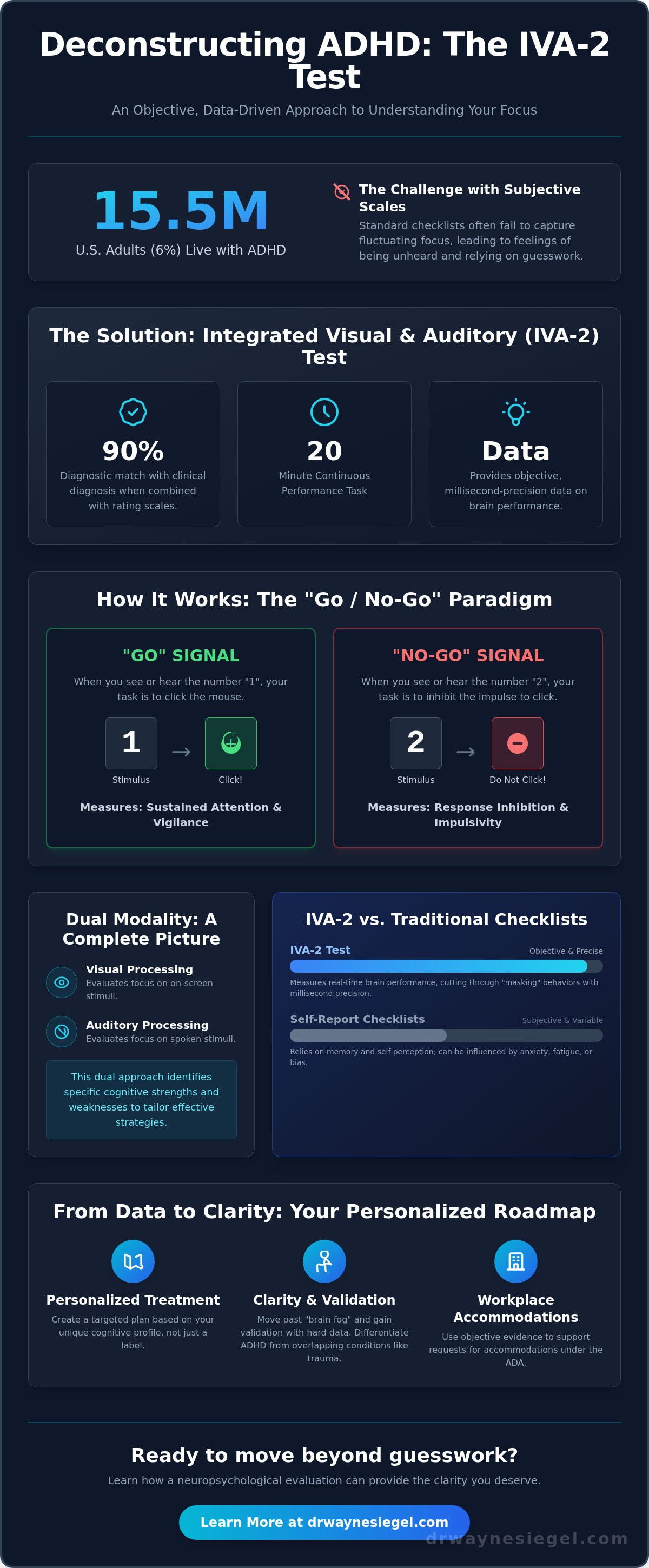
Did you know that 6% of adults in the U.S., roughly 15.5 million people, currently live with ADHD? Despite this prevalence, I often meet patients who feel a deep sense of anxiety that a standard checklist cannot fully capture their daily cognitive hurdles. It's difficult to explain why your focus fluctuates; relying solely on subjective scales can leave you feeling unheard. You deserve a diagnostic process that moves beyond guesswork and provides the validation of hard data through tools like the iva test.
I use the 2024.20 software version of this assessment, which was released on November 27, 2024, to bridge the gap between your personal experience and clinical evidence. A validity study found that when we combine ADHD rating scales with this specific testing, the results match a clinical diagnosis 90% of the time. In this article, I'll explain how this precision tool works to measure your visual and auditory processing. You'll learn how we use these objective metrics to move past the "brain fog" and create a personalized roadmap for your treatment and workplace accommodations under the ADA.
Key Takeaways
- Learn how the iva test utilizes a dual-modality approach to evaluate both visual and auditory processing, offering a more complete picture of your cognitive strengths.
- Understand the "Go/No-Go" mechanism that measures your brain's ability to inhibit responses, providing objective data on impulsivity that subjective checklists often miss.
- Discover the clinical advantages of combining performance-based testing with traditional scales to achieve a more rigorous and reliable diagnosis.
- Find out what to expect during the 20-minute assessment, including how we'll ensure your results are accurate through controlled environmental settings.
- Gain clarity on how your cognitive profile serves as a personalized roadmap, helping us see if it's ADHD or an overlapping condition like trauma.
What is the IVA-2 Test in Clinical Psychology?
The Integrated Visual and Auditory (IVA-2) test is a sophisticated diagnostic tool that I use to bring objective clarity to the ADHD assessment process. At its core, it's a computer-based Continuous Performance Task (CPT) designed to evaluate two primary pillars of executive functioning: sustained attention and response inhibition. While many people associate ADHD with childhood, I find this test especially vital for adults. By the time we reach adulthood, we've often developed complex "masking" behaviors that can make traditional checklists less reliable. The iva test cuts through these coping mechanisms by measuring your brain's actual performance in real-time, providing a data-driven foundation for our clinical partnership.
In my practice, I view the diagnostic process as a journey toward understanding the "why" behind your daily struggles. Clinical interviews and self-report scales are essential because they capture your lived experience; however, they rely on memory and self-perception, which can be influenced by anxiety or fatigue. The IVA-2 complements these insights by providing hard data. It records your reaction times and accuracy with millisecond precision, ensuring that our final assessment isn't just based on an opinion, but on verifiable evidence of how your brain processes information.
The Role of CPTs in Modern Diagnostics
Continuous Performance Testing has undergone a significant transformation since its early research applications. It's now a cornerstone of evidence-based practice. I rely on the IVA-2 because it's a standardized instrument that helps remove the "noise" of human bias from the diagnostic equation. It's often considered a gold standard because it requires the brain to maintain focus during repetitive, intentionally "boring" tasks. This specific challenge is where executive functioning deficits become most apparent. By using a research-based tool like the iva, I can provide you with a high level of diagnostic integrity, moving us closer to a solution that improves your daily quality of life.
Visual vs. Auditory Processing in ADHD
ADHD is rarely a "one size fits all" condition; it often manifests differently across different senses. Some of my patients find they can focus well on a spreadsheet but lose the thread of a conversation within minutes. Others experience the exact opposite. The IVA-2 is unique because it toggles between visual and auditory stimuli throughout the 20-minute session. This dual-modality approach is crucial for building a complete cognitive profile. If the data shows a significant discrepancy between your sight and sound processing, it changes our roadmap for treatment. For example, knowing you have an auditory processing strength allows us to tailor workplace accommodations or study habits specifically to those strengths. This level of detail ensures that your diagnosis is a tool for empowerment rather than just a label.
How the IVA-2 Test Works: The Science of Attention
The iva test operates on a rigorous scientific framework known as the "Go/No-Go" paradigm. This mechanism is designed to challenge your brain's executive control by requiring you to make split-second decisions. During the 20-minute session, you'll be presented with a series of visual and auditory stimuli. Your task is simple yet demanding: click the mouse when you see or hear the number "1" (the Go signal), and refrain from clicking when you see or hear the number "2" (the No-Go signal). This process allows me to capture objective data on how well your brain can inhibit an impulse while maintaining a high level of vigilance.
One of the most revealing aspects of the 2024.20 software version is how it utilizes stimulus frequency to uncover cognitive struggles. The test intentionally creates periods of "boredom" by reducing the frequency of the target stimuli. For many adults with ADHD, the brain begins to seek out internal stimulation when external input is low, leading to lapses in focus. By measuring your reaction time and fine motor control during these lulls, we can see exactly where sustained attention begins to waver. If you're ready to see how this data can clarify your own experience, you can learn more about my approach to neuropsychological evaluations.
Your performance isn't analyzed in isolation. The system compares your specific results against a vast normative database of age-matched peers. This comparison is vital because it provides a benchmark for what's considered typical cognitive functioning for your demographic. Instead of relying on a "gut feeling" or a subjective self-report, we use this research-based comparison to determine if your challenges with focus and impulsivity are statistically significant.
Measuring Impulsivity and Hyperactivity
Impulsivity is measured through what we call "commission errors." These occur when you click the mouse in response to a "2" instead of waiting for a "1." Commission errors are an indicator of impulsive responding. In our data analysis, I distinguish between simple impulsivity, which is a quick reactive click, and complex impulsivity, which often reveals a struggle to switch between visual and auditory processing modes. These metrics help me understand the "why" behind moments where you might act before thinking in your daily life.
Tracking Inattention and Focus Variability
Inattention is tracked through "omission errors," which happen when you fail to click when a "1" is presented. While missing a target is important, the most critical marker for ADHD is often reaction time variability. This measures the consistency of your response speed throughout the entire test. I look for patterns that distinguish between simple fatigue, which usually shows a steady decline at the end of the 20 minutes, and the chronic inconsistency that characterizes ADHD. This distinction is essential for building an accurate roadmap for your treatment and growth.
IVA-2 vs. Other ADHD Assessment Tools
When you're seeking a diagnostic path, it's helpful to understand how the iva test differs from other common options like the Test of Variables of Attention (TOVA). Both are high-quality instruments, but the TOVA typically evaluates a single sensory modality at a time. The IVA-2 is more complex. It requires your brain to switch between visual and auditory tasks within the same 20-minute window. This multimodal approach provides a more nuanced view of how you function in a busy office or classroom. It's a foundational component of a psychological assessment near me that prioritizes evidence over anecdote.
I often see patients who've spent years completing the Adult ADHD Self-Report Scale (ASRS). These scales are useful for identifying symptoms you've noticed, but they're inherently subjective. A 2025 CDC report indicates that over half of adults with ADHD weren't diagnosed until adulthood. Many individuals "mask" their symptoms or have high intelligence that compensates for executive deficits on simple checklists. Objective performance data provides the missing piece of the puzzle. It validates your internal struggle with measurable proof.
Strengths and Limitations of Computerized Testing
The primary benefit of the iva is the elimination of clinician bias. The scoring is standardized and automated. This means your results aren't influenced by a provider's subjective impressions or a bad day. However, computerized testing has its limits. It must be interpreted within a full clinical context. No single test can "diagnose" ADHD on its own. It requires an expert to integrate these scores with your developmental history and current life stressors. This integration is what transforms raw data into a meaningful diagnosis.
Integrating IVA-2 with Evidence-Based Interviews
I believe in a "whole-person" view of mental health. This means I combine your test data with a deep-dive clinical interview and behavioral observations. This multi-method approach is essential for a valid diagnosis. When the data from the IVA-2 aligns with your reported history, it creates a powerful sense of validation. It confirms that your focus issues are rooted in neurobiology rather than a lack of effort. Professional interpretation ensures that we use this data to build a practical roadmap for your future.
What to Expect During Your IVA-2 Testing Session
I want you to feel fully prepared and at ease before your session begins. The testing environment is a critical factor in the validity of our results. In my practice, we ensure the room is quiet and free from visual clutter. This control is necessary because the iva test is designed to measure your internal focus without the interference of outside noise. We'll start with a guided practice round. This short trial ensures you're comfortable with the interface before we move into the actual 20-minute assessment. It's a period of sustained mental effort, and I'll be there to guide you through the transition from practice to performance.
The rise of interjurisdictional practice has made this level of diagnostic precision more accessible than ever. I'm able to provide these evaluations to patients living across various psypact states. Whether we meet in person or through a secure telehealth platform, the protocol remains rigorous. Once you complete the test, the software generates a detailed report based on the 2024.20 version released on November 27, 2024. I then spend time analyzing this raw data to prepare for our follow-up meeting. We'll sit down together to translate these numbers into a clear, actionable roadmap for your daily life.
Preparing Your Mind and Body
To get the most accurate snapshot of your executive functioning, I recommend arriving well-rested. Evidence suggests that sleep deprivation can mimic ADHD symptoms on a CPT. Aim for 7 to 9 hours of sleep the night before. Consistency is also key with caffeine; if you drink coffee every morning, do so on your testing day. If you're already taking ADHD medication, we'll discuss whether to continue it during the test based on our specific diagnostic goals. I use a person-centered approach to help manage any anxiety you might feel. Remember, this isn't an "exam" you can fail. It's a tool to help us understand how your brain works. If you're ready to start this journey, you can reach out to my office to begin the process.
Remote Testing Logistics via Telehealth
Remote administration requires specific technical standards to ensure data integrity. The iva software requires a computer running Windows 11 and is not compatible with macOS. During a telehealth session, you'll need a quiet, private space where you won't be interrupted for at least 30 minutes. We'll also verify your screen size and audio quality before we start. These steps allow us to maintain the same standardized conditions found in a clinical office. This convenience ensures that high-quality, research-based testing is available to you regardless of your physical location.
From Data to Clarity: Using IVA-2 Results for Growth
I view the completion of the iva test as the start of a transformative phase in your care. The data we collect isn't just a set of numbers; it's a high-resolution map of your cognitive landscape. Instead of simply providing a label, these results allow us to build a precise roadmap for your daily life. If your scores show high reaction time variability, it confirms that your focus isn't "broken" but rather inconsistent. This insight is vital when we translate your results into workplace or academic accommodations. We can use this evidence to advocate for specific needs, such as a quiet workspace or tasks broken into smaller segments, ensuring you have the environment necessary to thrive.
Accuracy is essential when symptoms overlap with other conditions. For example, the hypervigilance and cognitive fatigue associated with trauma can often mimic ADHD. By analyzing your specific performance patterns, I can determine if we need to focus on ptsd counseling to address the root cause of your attention struggles. This evidence-based approach ensures that your treatment plan is as unique as your history. It moves us beyond guesswork and toward the clinical clarity required for long-term recovery and improved daily quality of life.
Developing a Personalized Treatment Plan
We use the strengths identified during your testing to bypass executive function gaps. If your data reveals that your visual processing is significantly more robust than your auditory processing, we'll prioritize visual organizational tools in your strategy. These metrics also serve as a reliable baseline. As we work together in therapy, we can track how your cognitive profile evolves over time. It's a collaborative effort where I help you find actionable meaning in the numbers, turning raw data into a plan for success. Using the iva results this way ensures therapy is targeted and efficient.
Empowerment Through Understanding
Many of my patients feel a profound sense of relief when they see their struggles documented as measurable cognitive patterns. It helps to dissolve the shame often tied to years of being told they were "lazy" or "not trying hard enough." You're not failing; your brain simply processes information in a specific way. Having a professional, research-based explanation for your challenges is incredibly empowering. It provides a stable foundation from which you can grow. If you're ready to find this level of understanding, the next step is to schedule your comprehensive evaluation so we can begin building your roadmap together.
Start Your Journey Toward Cognitive Clarity
Gaining a precise understanding of your focus shouldn't be a matter of guesswork. The iva test provides the objective, performance-based data needed to validate your daily struggles and move beyond the limitations of subjective checklists. By measuring reaction times and response inhibition across both visual and auditory senses, we create a reliable foundation for your treatment roadmap. This evidence-based approach ensures that your diagnosis is accurate, actionable, and focused on improving your quality of life.
I bring more than 25 years of experience as a board-certified clinical psychologist to every evaluation. My practice utilizes rigorous, research-backed protocols to help you uncover the "why" behind your challenges. With the reach of PsyPact, I can offer this clinical expertise to individuals across multiple states via secure telehealth. You deserve a partner who values both the science of the brain and the person behind the symptoms. Schedule a consultation to gain clinical clarity with a comprehensive ADHD assessment. Let's work together to turn your data into a clear path forward.
Frequently Asked Questions
Is the IVA-2 test accurate for diagnosing ADHD in adults?
The iva test is highly accurate when integrated into a comprehensive diagnostic protocol. A validity study found that combining ADHD rating scale data with this assessment matched clinical diagnoses 90% of the time. It provides the objective performance data that subjective interviews might lack. This ensures that your diagnosis is grounded in research-based metrics rather than personal observation alone.
How long does the IVA-2 test take to complete?
The core assessment takes approximately 20 minutes to finish. However, you should plan for a 45-minute session to account for instructions and the mandatory practice rounds. These practice segments are crucial because they ensure you understand the "Go/No-Go" task before the software begins recording your data. This structure helps minimize errors caused by confusion rather than cognitive challenges.
Can I take the IVA-2 test online through telehealth?
Yes, you can complete the evaluation remotely if you live in one of the approved PsyPact states. You must have a computer running Windows 11, as the 2024.20 software version of the iva isn't compatible with macOS. I'll provide a secure link to ensure the testing environment meets clinical standards. This allows for national access to high-quality diagnostics from your home.
What is a 'good' score on the IVA-2 test?
There isn't a single "passing" score; instead, your results are compared to a database of age-matched peers. A standard score of 100 represents the average, with scores above 85 typically falling within the normal range. I look for specific patterns in your reaction time and consistency. These metrics help me build a roadmap for your treatment based on your unique cognitive profile.
Do I need to stop taking my ADHD medication before the test?
The decision to pause medication depends on whether we're establishing a baseline or measuring treatment efficacy. If we're seeking an initial diagnosis, I often recommend a 24-hour wash-out period. However, you must consult with your prescribing physician before making any changes. We'll discuss your specific medication history during our initial consultation to ensure the data is valid and safe.
What happens if I get distracted during the IVA-2 test?
Getting distracted is actually a measured part of the assessment process. Lapses in focus are recorded as "omission errors," while impulsive clicks are "commission errors." The test is designed to be repetitive to see how your brain handles "boredom" over 20 minutes. These errors provide the evidence I need to understand your specific executive functioning challenges in real-world scenarios.
How does the IVA-2 differ from a standard IQ test?
An IQ test measures your cognitive potential and intellectual abilities, while the IVA-2 measures the "delivery system" of that intelligence. You can have a high IQ but still struggle with the sustained attention required to apply it. The test focuses specifically on impulsivity and attention. This distinction is vital because it explains why high-achieving adults often struggle with daily task completion.
Will insurance cover the cost of an IVA-2 assessment?
Many insurance plans cover this testing when it's billed as part of a larger neuropsychological evaluation. I use standard CPT codes like 96130 or 96131 for these assessments. You should contact your provider to verify your specific benefits for ADHD testing. While some clinics like Foresight Mental Health offer a self-pay rate of $200, every practice has different billing structures.