
What Is Emotional Dysregulation? A Clinical Guide to Understanding and Management in 2026

What if the intense reactions that make you feel hijacked by your own mind aren't actually a part of your personality, but a specific clinical symptom? I understand how exhausting it feels to be overwhelmed by your own nervous system, especially when those intense reactions begin to fray the bonds of your most important relationships. Understanding what is emotional dysregulation is the first step toward reclaiming a sense of calm and moving beyond the confusion of these experiences. Data from 2024 clinical updates in neuropsychology suggests these patterns are often rooted in the brain's executive functioning and prefrontal cortex regulation rather than a character flaw.
By reading this guide, you'll gain clinical clarity on the neurological mechanisms of your experience and discover evidence-based pathways to regain stability and control. We'll explore the "why" behind the intensity of your feelings and provide a clear roadmap for professional intervention. My goal is to help you move beyond labels to find actionable meaning that improves your daily quality of life and restores your sense of agency.
Key Takeaways
- Gain clinical clarity on what is emotional dysregulation by learning to distinguish between healthy emotional expression and persistent patterns of clinical dysregulation.
- Understand the neuropsychological interplay between the amygdala’s "alarm system" and the prefrontal cortex’s role in managing impulsive emotional responses.
- Identify the physiological and psychological triggers—ranging from sleep deprivation to sensory overload—that often serve as the foundation for emotional instability.
- Explore evidence-based pathways, including CBT and ACT, designed to help you challenge "hot thoughts" and increase your psychological flexibility.
- Discover why a professional neuropsychological assessment is the essential first step in creating a personalized roadmap toward genuine emotional stability and health.
Defining Emotional Dysregulation: Beyond Strong Feelings
When you're navigating a difficult day, it's natural to feel a surge of frustration or sadness. However, there's a clinical threshold where intense feelings transition from a natural response into a functional challenge. Emotional dysregulation refers to a persistent difficulty in modulating or managing one's affective state to return to a baseline of calm. While healthy emotional expression allows for the experience of feelings without losing control, a dysregulated state often feels like being swept away by a current that's too strong to swim against. I often tell my patients that it isn't the presence of the emotion that's the issue, but rather the inability to dial it back once the initial trigger has passed.
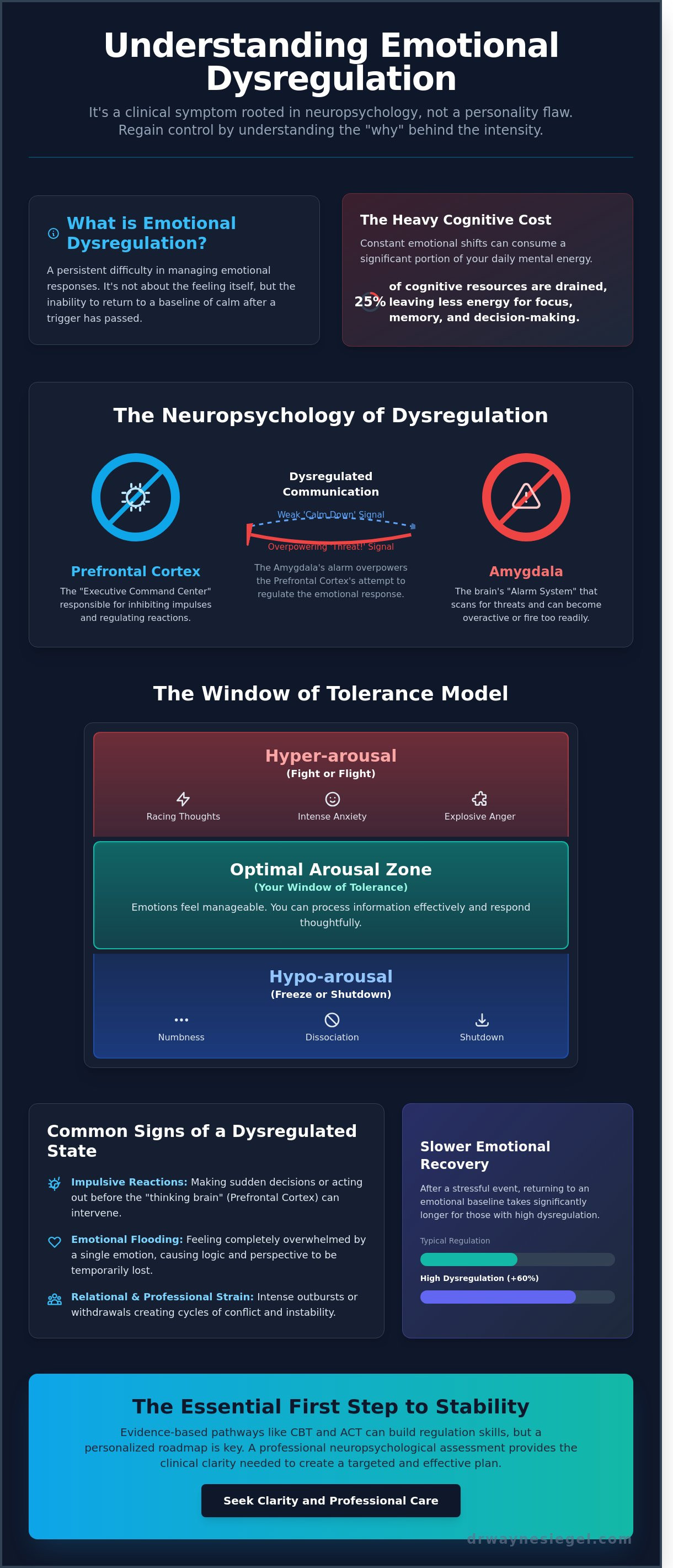
Understanding what is emotional dysregulation requires us to look at emotional lability. This term describes rapid, often unpredictable shifts in mood that don't seem to match the situation at hand. This isn't just an emotional burden; it's a heavy cognitive one. Clinical observations suggest that constant emotional shifts can consume approximately 25% of an individual's daily cognitive resources. This leaves significantly less energy for executive functions like memory, focus, and complex decision-making, which is why you might feel mentally exhausted after a period of high emotional volatility.
The Window of Tolerance Model
I find the "Window of Tolerance" model, originally developed by Dr. Dan Siegel, to be one of the most helpful tools for gaining clarity on your internal state. This model describes the "Optimal Arousal" zone where emotions feel manageable and you can process information effectively. When stress pushes you outside this window, your nervous system reacts in one of two ways:
- Hyper-arousal: This is the "fight or flight" zone. It's characterized by racing thoughts, intense anxiety, or explosive anger. Your body is on high alert, and your rational brain often goes offline.
- Hypo-arousal: This is the "freeze" or "shut down" zone. It manifests as numbness, dissociation, or a heavy sense of depression. You might feel "spaced out" or unable to find the energy to respond to your environment.
Signs and Symptoms of a Dysregulated State
In my practice, I look for specific behavioral markers that indicate a person is struggling to stay within their window. It's not just about the intensity of the feeling, but the recovery time. A 2018 study published in the Journal of Affective Disorders noted that individuals with high dysregulation often take 60% longer to return to their emotional baseline after a stressful event compared to those with high regulation skills. Common signs include:
- Impulsive Reactions: Making sudden decisions or acting out before the "thinking brain" can intervene.
- Emotional Flooding: Feeling so overwhelmed by a single emotion that all logic and perspective are temporarily lost.
- Relational and Professional Strain: Intense outbursts or withdrawals that create a cycle of conflict, often leading to instability in long-term goals.
Identifying these patterns is the first step toward building a roadmap for recovery. By recognizing when you're slipping out of your window, we can begin to implement strategies that bring you back to a state of balance and insight.
The Neuropsychology of Dysregulation: Executive Function and the Brain
To understand what is emotional dysregulation, we must look at the physical architecture of the brain. The prefrontal cortex acts as the executive command center; it's responsible for inhibiting impulsive responses and keeping our reactions proportional to the situation. In a balanced system, this area regulates the amygdala, which functions as the brain's alarm system by scanning the environment for threats. When I work with patients in my practice, we often find that this communication loop is disrupted. The amygdala fires too readily, and the prefrontal cortex lacks the strength to dampen that signal effectively. For those seeking a foundational overview of these symptoms, understanding What Is Emotional Dysregulation and How Can You Cope? provides a helpful starting point for recognizing these internal patterns.
I view emotional control as a core pillar of executive functioning, standing alongside working memory and cognitive flexibility. If the brain's executive suite is under-resourced, the ability to self-soothe or "re-think" a situation becomes physically difficult. Top-down processing refers to the prefrontal cortex exerting conscious control over impulses, while bottom-up processing involves the amygdala and limbic system driving immediate, instinctive emotional reactions.
The ADHD and Dysregulation Connection
Approximately 70% of adults with ADHD report significant challenges with emotional impulsivity. This happens because ADHD isn't just about focus; it's a deficit in the brain's management system. Dopamine regulation plays a critical role here; this neurotransmitter influences the brain's ability to "pause" and evaluate a situation before the motor or emotional response is triggered. Without that pause, emotions feel immediate and overwhelming. Obtaining a psychological assessment near me is a vital step in determining if these emotional hurdles are rooted in an underlying executive function profile.
The Impact of Developmental Trauma
Early trauma can fundamentally re-wire the nervous system for chronic hyper-vigilance. When a child's environment is unpredictable, the amygdala remains in a state of high alert, which can lead to a baseline of what is emotional dysregulation in adulthood. Research indicates that chronic stress can increase the volume of the amygdala by up to 15%, making the "alarm" more sensitive to perceived rejection or danger. However, the concept of neuroplasticity offers profound hope. The brain remains capable of forming new neural pathways through evidence-based care. In my work with ptsd counseling, we focus on strengthening the prefrontal cortex's ability to regulate the nervous system, moving from reactive survival to intentional living.
If you feel your emotional responses are consistently out of sync with your intentions, I invite you to explore our diagnostic services to find the clarity you deserve.
Common Triggers and Co-occurring Clinical Conditions
Understanding what is emotional dysregulation requires us to look beneath the surface of the immediate reaction. In my practice, I view dysregulation not as a standalone diagnosis, but as a significant clinical symptom that signals an underlying struggle with internal or external demands. The DSM-5-TR does not list emotional dysregulation as a primary disorder; instead, it's a transdiagnostic feature found across various presentations. To find clarity, we must examine the "vulnerability-stress" model. This framework suggests that some individuals possess a biological predisposition for high emotional sensitivity, which, when met with specific environmental stressors, leads to a breakdown in self-regulation.
Physiological states often serve as the silent architects of a localized "tipping point." A 2011 study published in the Journal of Neuroscience demonstrated that sleep deprivation can increase amygdala reactivity by as much as 60%. When you're operating on less than six hours of sleep, your brain's ability to filter emotional stimuli diminishes. Chronic pain and nutritional imbalances, specifically fluctuations in blood glucose, similarly lower your threshold for frustration. These physical factors create a fragile foundation where even minor psychological triggers, such as a perceived slight or a momentary loss of control, can spark an intense emotional cascade.
Psychological triggers are equally potent. Social rejection, for instance, activates the same neural pathways as physical pain. When a person feels excluded or criticized, the brain's "alarm system" may overreact if the individual's baseline stress level is already elevated. Sensory overload, such as crowded spaces or persistent loud noises, can also saturate the nervous system, making it nearly impossible to maintain the "executive brakes" required for calm reflection.
Conditions Associated with Dysregulation
While I focus on the whole person rather than just a label, clinical categories help us build an actionable treatment roadmap. Approximately 75% of individuals diagnosed with Borderline Personality Disorder (BPD) experience severe emotional lability. In Bipolar Disorder, dysregulation often follows the shifts in mood energy, whereas in Complex PTSD, it stems from a nervous system stuck in a state of hyper-vigilance. We see a different manifestation in Generalized Anxiety Disorder, where dysregulation appears as "uncontrollable worry" used to avoid deeper emotions. In Depression, it may present as a profound inability to up-regulate positive affect. My goal is to use these insights to move beyond the name of the struggle and toward a functional solution.
Sensory Processing and Emotional Reactivity
The link between our environment and our internal state is direct and measurable. Sensory over-stimulation acts as a constant tax on your cognitive resources. If your environment is chaotic, your "vulnerability factor" increases, making you more susceptible to outbursts or shutdowns. I encourage my patients to identify their unique "vulnerability factors" to prevent reaching that tipping point. You can use this brief checklist to assess your current threshold:
- Physical State: Have I slept fewer than seven hours or missed a meal in the last six hours?
- Sensory Load: Am I currently in an environment with high noise, bright lights, or excessive "clutter"?
- Cumulative Stress: Have I experienced more than three "micro-stressors" (e.g., traffic, a difficult email, a late bill) today?
- Social Safety: Do I feel criticized or unsupported by the people currently around me?
Identifying these factors doesn't just provide an explanation; it offers a path toward mastery. By adjusting these variables, we can widen the window of tolerance and regain a sense of steady, quiet control over our daily lives.
Evidence-Based Pathways to Regulation: CBT, ACT, and Skill-Building
Understanding what is emotional dysregulation often begins with a fundamental shift in perspective. I tell my patients that the goal of our work isn't to delete difficult feelings or achieve a state of permanent calm. Instead, we focus on changing your relationship with those emotions. Research published in the Journal of Clinical Psychology (2022) indicates that structured skill-building can improve emotional control scores by 40 percent over a 12-week period. We move from being controlled by feelings to observing them with clarity.
The Role of Cognitive Behavioral Therapy (CBT)
CBT serves as a practical framework for identifying "hot thoughts," which are the immediate, reflexive ideas that trigger intense reactions. Through cognitive reappraisal, I help you learn to view a situation from a different, less threatening perspective. This isn't about "positive thinking"; it's about accurate thinking. I also emphasize behavioral activation to help stabilize your mood. By scheduling small, meaningful activities, we can increase regulation through action. My practice utilizes a person-centered approach to ensure these techniques feel relevant to your specific daily challenges.
Acceptance and Commitment Therapy (ACT) and Mindfulness
When we examine what is emotional dysregulation in a clinical setting, we often see a lack of psychological flexibility. ACT addresses this through cognitive defusion. This technique teaches you to see thoughts as just sequences of words rather than absolute truths. You also develop the "Observer Self," which creates a safe distance between your identity and the intense emotion. This distance allows you to practice "valued living." Even when you're dysregulated, your core values act as a compass, helping you make choices that align with the person you want to be.
Developing a Personal 'Regulation Toolkit'
Practical interventions are essential for managing moments of high intensity. The STOP skill (Stop, Take a breath, Observe, Proceed) acts as a mental circuit breaker. I recommend building a toolkit that includes physiological grounding and logic-based checks:
- The 5-4-3-2-1 Method: Ground yourself by naming five things you see, four you can touch, three you hear, two you smell, and one you can taste.
- Paced Breathing: Use a pattern where the exhale is longer than the inhale to physically signal to your nervous system that you're safe.
- Check the Facts: This skill helps you evaluate if the intensity of your emotion actually matches the gravity of the current situation.
It's vital to create a "calm-down plan" before a crisis occurs. Having a pre-written roadmap provides a sense of order when your internal world feels chaotic. If you're looking for a clear path forward, you can explore my approach to neuropsychological evaluations here.
Seeking Clarity through Psychological Assessment and Professional Care
Understanding what is emotional dysregulation is the first step toward a more stable life. However, knowledge alone doesn't provide a solution. A comprehensive psychological evaluation serves as the essential bridge between feeling overwhelmed and finding a clear path forward. Many people I see in my practice have spent decades "masking" their symptoms. Masking involves the exhausting process of mimicking social norms to hide internal distress. It differs fundamentally from true regulation, which is the internal capacity to modulate one's nervous system. As a board-certified psychologist, I use standardized data and clinical observations to build a personalized roadmap. This data-driven approach ensures we aren't just treating symptoms, but addressing the core cognitive and emotional drivers of your experience.
When to Seek a Professional Evaluation
Certain "red flags" indicate that professional intervention is no longer optional. If you experience suicidal ideation, engage in self-harm, or find that your reactions cause severe disruption to your career or home life, it's time to reach out. Clinical data suggests that early intervention significantly reduces the likelihood of developing chronic interpersonal conflict patterns. Seeking help is a sign of resilience. It shows a commitment to your well-being and a desire to stop the cycle of emotional volatility. A professional evaluation provides the diagnostic clarity needed to move from a state of crisis to a state of management.
- Safety Concerns: Any thoughts of self-harm or persistent suicidal ideation.
- Functional Impairment: Difficulty maintaining employment or stable housing due to emotional outbursts.
- Relational Strain: A pattern of intense, unstable relationships characterized by frequent conflict.
- Chronic Distress: Feeling "at the mercy" of your emotions on a daily basis.
The Path Forward with Siegel Psychology Services
My approach at Siegel Psychology Services is rooted in evidence-based care that remains thoroughly compassionate. I believe every patient deserves a precise understanding of their cognitive profile. We provide the convenience of national telehealth services for residents living in psypact states. This interjurisdictional framework allows you to access high-level clinical expertise regardless of your physical distance from the office. This accessibility is vital for maintaining the continuity of care required for complex emotional challenges.
If you're ready to move beyond the confusion of what is emotional dysregulation and into a life of stability, I'm here to help. My goal is to provide you with the insight and tools necessary to navigate your world with confidence. We focus on the whole person, ensuring the roadmap we build together leads to a measurable improvement in your daily quality of life. Contact my office today to start your journey toward clarity and emotional stability.
Finding Your Path to Emotional Stability
Understanding what is emotional dysregulation requires looking at the intersection of executive function and specific neurological response patterns. It's not a character flaw; it's a clinical challenge that responds to targeted, research-backed interventions. Peer-reviewed data indicates that evidence-based frameworks like Cognitive Behavioral Therapy (CBT) and Acceptance and Commitment Therapy (ACT) provide the most effective tools to stabilize complex emotional landscapes. I've spent more than 25 years as a board-certified clinical psychologist helping individuals translate these scientific insights into daily improvements in quality of life.
A thorough neuropsychological assessment acts as a roadmap, moving you beyond vague symptoms toward actionable clarity. By utilizing PsyPact telehealth services, I provide this expert level of care to patients across the country, ensuring that distance isn't a barrier to professional support. We'll work together to identify your unique cognitive profile and develop a strategy grounded in clinical rigor. You deserve a partner who values both the science of the brain and the person behind the data. Schedule a consultation with Dr. Wayne Siegel to gain clarity on your emotional health. Your journey toward a more balanced and predictable future begins with understanding the "why" behind your experiences.
Frequently Asked Questions
Is emotional dysregulation a mental illness?
Emotional dysregulation isn't a standalone mental illness; instead, it's a clinical symptom or a transdiagnostic feature found in various conditions. According to the DSM-5-TR, it appears in about 75 percent of individuals diagnosed with Borderline Personality Disorder and is a core component of Disruptive Mood Dysregulation Disorder. I view it as a vital signal that the brain's emotional processing centers, like the amygdala, are working overtime and need support.
Can emotional dysregulation be cured, or is it permanent?
It's not a permanent sentence; emotional dysregulation is a highly treatable condition through targeted interventions and neuroplasticity. Research into brain health shows that the brain can create new pathways for regulation at any age. Studies on Dialectical Behavior Therapy indicate that 77 percent of patients no longer meet the full criteria for their primary dysregulation disorder after one year of consistent treatment. I work with you to build a roadmap for these lasting changes.
How is emotional dysregulation different from ADHD?
The primary difference lies in the source of the struggle, though they often overlap in clinical practice. ADHD is a neurodevelopmental disorder focused on executive function deficits like focus and inhibition. To understand what is emotional dysregulation in this context, we look at emotional impulsivity, which affects roughly 70 percent of adults with ADHD according to a 2014 study by Dr. Russell Barkley. It's a specific difficulty in inhibiting an immediate emotional reaction.
What is the fastest way to stop a dysregulated episode?
The fastest way to interrupt an episode is through physiological interventions that signal the nervous system to calm down immediately. I recommend using TIPP skills, specifically cold water immersion. Splashing your face with water below 50 degrees Fahrenheit for 30 seconds triggers the mammalian dive reflex. This biological response naturally slows your heart rate and redirects blood flow to the brain, providing the clarity needed to regain control of your day.
Is emotional dysregulation the same as a temper tantrum?
No, these two experiences are fundamentally different in their biological origin and intent. A temper tantrum is often a goal-oriented behavior used to achieve a specific outcome or reward. In contrast, emotional dysregulation is a physiological breakdown where the prefrontal cortex loses its ability to manage the limbic system. It's an involuntary state of distress rather than a choice, often leaving the person feeling exhausted and remorseful once the episode passes.
Can trauma cause emotional dysregulation later in life?
Yes, trauma significantly alters how the brain processes stress, even decades after the original event occurred. The 1998 Adverse Childhood Experiences study demonstrated that individuals with higher trauma scores are 2.5 times more likely to struggle with emotional control as adults. These experiences can sensitize the hypothalamic-pituitary-adrenal axis. I help you identify how these past neurological imprints are currently impacting your daily quality of life and your sense of stability.
Does insurance cover psychological testing for dysregulation?
Most major insurance providers cover neuropsychological testing when it's deemed medically necessary to determine a diagnosis or guide treatment. I recommend checking your specific policy for CPT codes 96132 and 96133, which are the standard industry codes for evaluation services. While I don't provide specific costs, a 2023 report from the American Psychological Association notes that diagnostic clarity from testing often reduces long-term healthcare spending by 20 percent through better targeting.
What happens if emotional dysregulation is left untreated?
Leaving these symptoms unaddressed can lead to a significant decline in both physical health and social functioning over time. Chronic stress from untreated episodes increases the risk of cardiovascular disease by 40 percent according to long-term longitudinal studies. Understanding what is emotional dysregulation is the first step in avoiding these outcomes. Without a clear roadmap for management, individuals often face job instability, relationship breakdown, and a persistent sense of cognitive or emotional disarray.